

Think about the last week. How many times did someone ring your doorbell and you had no idea who it was until you opened the door — or did not open it at all? Your domestic help arriving at 6 AM. A courier attempting a delivery at 2 PM while you are on a call. An unfamiliar face at 9 PM who could be a neighbour or could be anyone.
Right now, your options are limited: ignore it, squint through a peephole, or take the risk of opening the door. A video door phone changes all three of those situations. But whether you actually need one — and which kind — depends significantly on your home type, your daily routine, and what problem you are really trying to solve.
This guide explains what a VDP is, how it differs from a smart video doorbell, which wiring setup makes sense for your home, and — most importantly — gives you an honest answer on whether you genuinely need one or whether a different security solution serves you better.
Key Takeaways
| 💡 A video door phone (VDP) connects an outdoor camera and speaker unit to an indoor monitor or your phone, letting you see, hear, and speak to visitors before opening the door. 💡 VDPs and smart video doorbells are different products: VDPs have dedicated indoor monitors and local wired operation; smart doorbells are app-first and cloud-dependent. 💡 Wired VDPs continue working during Wi-Fi outages — core functions run locally. Smart doorbells go offline if your internet drops. 💡 Independent houses and villas benefit most from a dedicated VDP; gated community apartments often already have building-level intercom and only need a unit-level solution. 💡 VDP paired with a smart door lock lets you verify a visitor and remotely unlock the door from the same interface — without leaving your seat. 💡 A VDP and a CCTV camera do different jobs: VDP is for visitor communication and access control; CCTV is for surveillance and recording. They are complementary, not interchangeable. 💡 Night vision, 1080p resolution, wide-angle lens, and smart lock integration are the features worth paying for. Facial recognition and 4K at front-door distances add cost without proportional value. 💡 Yes We Technologies installs wired and wireless VDP systems across Bangalore, integrated with smart locks, CCTV, and home automation. |
What a Video Door Phone Is and How It Works
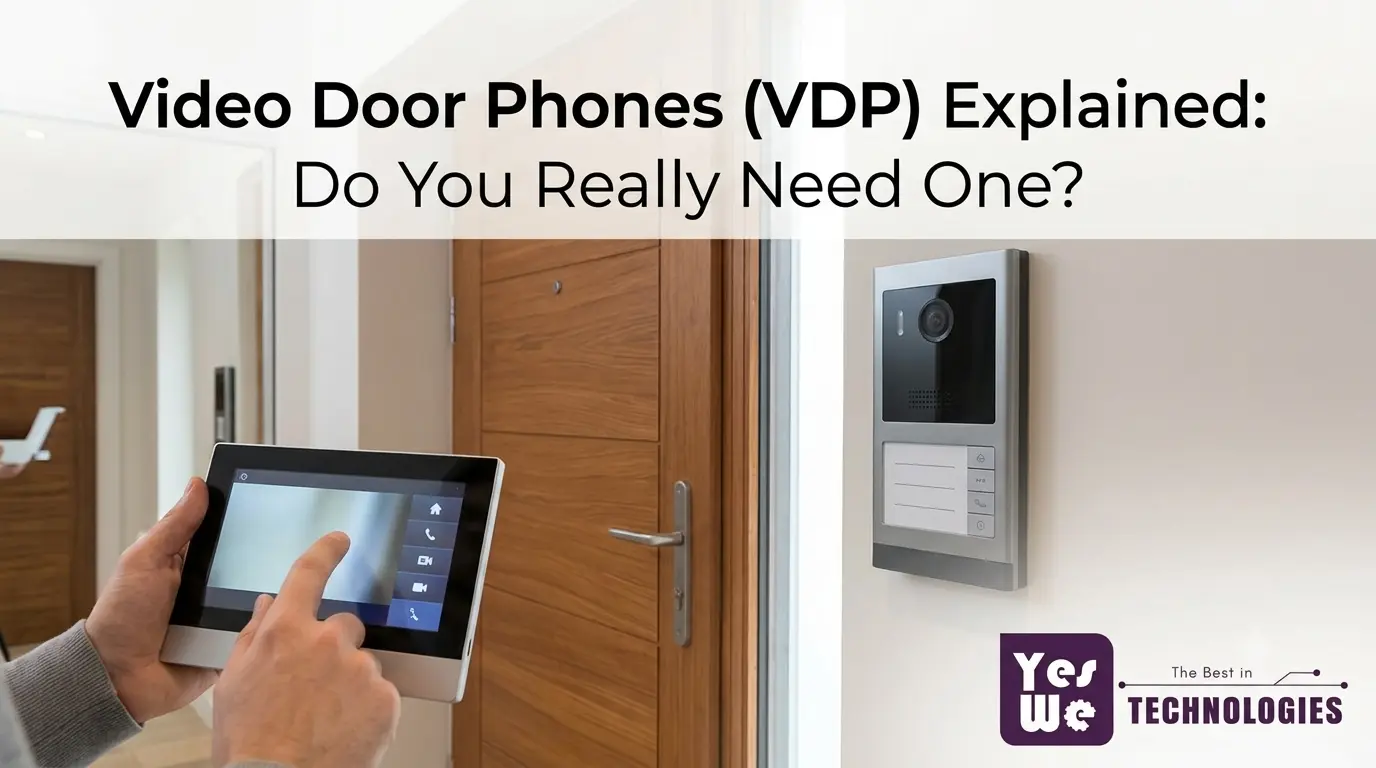
A video door phone is a communication and access control system installed at your front entrance. It has three components working together: an outdoor unit at the door, an indoor unit inside the home, and the connection between them.
The Three Components
- Outdoor door station: A weatherproof unit mounted beside your door or gate. It contains a camera, a microphone, a speaker, and a call button. When a visitor presses the button, it triggers the indoor unit.
- Indoor monitor or app: A wall-mounted screen inside your home that displays the live camera feed when the bell rings. On Wi-Fi-enabled systems, your smartphone app works as the indoor monitor instead.
- Door release: Most VDP systems connect to an electronic door strike or smart lock, letting you unlock the door remotely after identifying the visitor — without getting up.
When the outdoor bell is pressed, you see and hear the visitor on the indoor monitor or phone, speak to them through two-way audio, and choose to open the door remotely or ask them to wait. At no point do you need to approach the door or open it until you are confident about who is there.
VDP vs Smart Video Doorbell: Two Different Products
These terms get used interchangeably in most buying guides, and they should not. They are different products solving the same problem in different ways, with different trade-offs:
| Feature | Traditional VDP | Smart Video Doorbell (Ring, Qubo, TP-Link) |
|---|---|---|
| Indoor monitor | Dedicated wall-mounted screen | Your smartphone is the monitor |
| Works without Wi-Fi | Yes — wired systems run locally | No — entirely app and cloud dependent |
| Works during internet outage | Yes (wired) — core functions work | No — camera goes offline |
| Multiple indoor monitors | Yes — useful in large homes | No — all on phone |
| Best suited for | Independent houses, villas, multi-room homes | Apartments, rentals, quick retrofit |
| Installation | Professional recommended | DIY-friendly |
| Smart lock integration | Yes — deep, wired integration | Yes — via app |
| Remote access | Yes on Wi-Fi-enabled VDPs | Yes — primary feature |
| Price range (India) | Rs 5,000 to Rs 30,000+ | Rs 3,000 to Rs 15,000 |
The key distinction that matters most in India: a wired VDP has local independence. If your internet goes down at 10 PM and someone rings the bell, the indoor monitor still shows the camera feed, two-way audio still works, and the door release still functions. A smart doorbell app on your phone shows nothing until connectivity is restored.
Wired vs Wireless VDP: Which Makes Sense for Your Home?
After understanding what a VDP is, the most consequential decision is how it connects — because this determines reliability, installation complexity, and which home types it suits.
Wired VDP
A wired VDP connects the outdoor door station and indoor monitor through a dedicated two-wire cable. Power runs through the same cable. The system operates entirely on your home network — no Wi-Fi, no internet, no cloud required for basic operation.
- Reliability: the highest available — no signal loss, no dropped connections, no dependency on internet uptime
- Power cut resilience: with a UPS on the indoor unit, the system continues through power interruptions
- Video quality: consistent high-definition without the compression that wireless streaming introduces
- Installation: requires cable routing between the outdoor unit and indoor monitor — straightforward in independent houses during construction or renovation, more complex in finished flats
- Best for: independent houses, villas, and any home where the cable can be routed cleanly
Wi-Fi-Enabled VDP and Smart Doorbells
Wi-Fi VDPs and smart doorbells send video over your home wireless network to an app on your phone. Installation involves mounting the outdoor unit, connecting it to power, and pairing with your Wi-Fi — no cable needed between outdoor and indoor units.
- Flexibility: the outdoor unit and indoor monitor (your phone) have no physical connection, so placement is not constrained by cable runs
- Remote access: you can see and speak to a visitor from anywhere in the world, not just from inside the home
- Dependency: everything stops working if your Wi-Fi drops or your internet goes down
- Best for: apartments, rental properties, homes where cable routing is impractical, and anyone who wants remote access as the primary feature
| Factor | Wired VDP | Wi-Fi VDP / Smart Doorbell |
|---|---|---|
| Works during internet outage | Yes — fully local | No — goes offline |
| Works during Wi-Fi drop | Yes | No |
| Installation complexity | Moderate — cable routing required | Low — mount and pair |
| Video reliability | Consistent, high bitrate | Varies with Wi-Fi signal strength |
| Remote access (away from home) | Only on Wi-Fi-enabled wired models | Yes — primary strength |
| Best property type | Independent house, villa | Apartment, rental, retrofit |
| Bangalore Tip: Many gated communities in Whitefield, Koramangala, Sarjapur Road, and Hebbal already have a wired VDP system at the building lobby managed by the RWA. This handles visitor verification at the gate. A Wi-Fi doorbell or compact VDP at your flat door adds a second verification layer specifically for your unit entrance — the two systems serve different points in the visitor’s journey. |
Do You Actually Need a Video Door Phone?
This is the question most guides avoid answering honestly. Every brand-published article says yes. The honest answer is: it depends on your home type and what you are trying to solve.
You Clearly Benefit From a VDP If
- You live in an independent house or villa where you cannot see who is at the gate or front door from inside — a VDP is the standard solution for this exact situation
- You have domestic help, delivery personnel, or service technicians arriving throughout the day and you want to verify before opening
- You have elderly family members, young children, or anyone at home alone who should not be opening the door to unverified visitors
- You regularly miss deliveries or miss visitors because you are in another room or on a call and do not want to walk to the door every time the bell rings
- You want to grant access to a trusted visitor — your parent, a known delivery, household help — remotely when you are not home
- Your front door opens directly to a street, compound, or any area where unverified access is a genuine security concern
You Probably Do Not Need a Standalone VDP If
- You live in a gated community apartment where the building already has a functional lobby VDP or intercom, your flat is on an upper floor, and your corridor is well-lit and managed — the building system already does the heavy lifting
- Your primary concern is recording and surveillance rather than visitor communication — in that case, a CCTV camera covering your entrance is the more appropriate solution (different purpose, different device)
- You are in a short-term rental and the installation complexity does not justify the investment — a smart doorbell camera with a removable mount is a better fit
- You live alone and are almost always home and alert when someone rings — the value of verification-before-opening is lower when you are consistently available to assess the situation
The VDP vs CCTV Confusion
This comes up often: people ask whether they should get a VDP or a CCTV camera at their front door. The answer is that they do different jobs.
A VDP is a communication device. Its primary function is letting you see and speak to a visitor and decide whether to let them in. It has a call button, two-way audio, and a door release. It is an access control tool.
A CCTV camera is a surveillance and recording device. It captures footage continuously or on motion trigger. It does not ring a bell, it does not let you speak to a visitor, and it does not control access. If your requirement is monitoring and recording who approaches your property, a CCTV camera system in Bangalore is the right tool. If your requirement is visitor verification and controlled access, a VDP is the right tool. For complete home security, most independent houses need both — and they work well together.
Features Worth Paying For vs Features That Sound Good on Paper
VDP pricing in India ranges from Rs 3,000 for a basic wired monitor system to Rs 30,000 or more for a full IP-based smart system with cloud recording and smart lock integration. Here is how to decide what to pay for.
Features Worth Every Rupee
- 1080p HD resolution: The baseline for reliable face identification. At front-door distances (typically 1 to 2 metres), 1080p provides clear enough detail to identify a face confidently, day and night. Do not go lower than this.
- Night vision with IR illumination: Most incidents involving strangers at the door happen in the evening. A VDP that shows a blurry silhouette at night provides a false sense of security. Confirm the night vision range covers your full approach area — typically 5 to 10 metres for residential doors.
- Wide-angle lens (100 to 140 degrees): A narrow field of view shows one person standing directly in front of the camera. A wide-angle lens shows everyone at the doorstep, including people standing to the side or approaching. This is particularly important for gate-level installations.
- Two-way audio clarity: Clear audio in both directions matters significantly. A VDP with poor microphone pickup requires visitors to shout, which undermines the whole experience. Test or check reviews specifically on audio quality, not just video.
- Smart lock integration: The ability to unlock the door remotely from the same interface after verifying the visitor is the feature that makes a VDP genuinely useful rather than just informative. Without it, you still have to get up and open the door manually.
- Motion detection and recording: Captures footage even when nobody presses the bell — useful for monitoring delivery drops, vehicle movements near your gate, or repeated approaches by the same person at unusual hours.
Features That Add Cost Without Proportional Value
- 4K resolution at the front door: At 1 to 2 metre door distances, 1080p is sufficient for face identification. 4K adds file size, storage cost, and processing demand without delivering meaningfully better usability at this range.
- Facial recognition: Useful in commercial buildings with access logs and employee management systems. In a residential home, you look at the screen, recognise the face yourself, and press the button. AI recognition adds cost for a task your own recognition handles in half a second.
- Two-way video (visitor sees you): Most homeowners disable this feature after the first week. The value of a VDP is asymmetric — you see and screen the visitor; they do not need to see you to understand you are communicating with them.
- Package detection AI: Not mature enough to be reliable in Indian residential contexts as of 2025. Standard motion detection does the same job adequately.
Where a VDP Becomes Significantly More Valuable: Smart Home Integration
A standalone VDP is useful. A VDP connected to your smart door lock, your CCTV system, and your home automation is a different category of experience.
VDP Plus Smart Door Lock
This is the combination that makes a VDP genuinely transformative for daily life. The visitor rings the bell, the camera feed appears on your monitor or phone, you verify the face, and you press unlock — all from the same interface, from anywhere in the home or anywhere in the world. No walking to the door, no fumbling with a key, no opening to an unverified person. This integration between VDP and smart door locks in Bangalore (yeswe.in/automation/smart-door-locks/) is one of the most immediately impactful smart home upgrades for any home with regular visitor traffic.
VDP Plus CCTV
A VDP covers one point: your front door. A CCTV system covers the full property — all approaches, the compound, parking, garden, and any secondary entrances. These are not competing products; they work as a layered security system where the VDP handles active visitor communication and the CCTV handles passive surveillance and recording across the whole property.
When both systems are connected to the same app or monitoring interface, you get a complete picture: you see who is at the door and you can review footage of how they approached, whether they came alone, and what happened before and after the bell rang.
VDP as Part of a Home Automation Scene
When a VDP is integrated into a wider home automation system in Bangalore, the doorbell trigger can activate a scene: the living room TV pauses, the nearest smart light turns on to full brightness, the camera feed appears on your TV or tablet, and a notification arrives on your phone — all simultaneously when the bell rings. For elderly family members or anyone who may not always carry a phone, the TV-based feed is particularly practical.
Gated Community Integration in Bangalore
In premium gated communities from Prestige, Brigade, Sobha, and Godrej across Whitefield, Sarjapur Road, Koramangala, and Hebbal, the building-level VDP system at the lobby and gate is typically managed by the RWA. Visitors press a button at the lobby, the feed comes through to your indoor unit or phone, you approve entry, and the boom barrier or lobby door releases automatically. This is the building’s common system — you use it but cannot modify it.
At your flat’s own front door, a separate compact VDP or smart doorbell camera adds a second verification layer specific to your unit entrance. The building system handles the common entry; your unit VDP handles the last metre between your corridor and your living room.
Video Door Phone Installation in Bangalore: Yes We Technologies
A VDP is most valuable when it is correctly specified for your home type, properly installed so the camera angle and night vision actually cover your approach area, and connected to your smart lock and CCTV in a single integrated system.
Yes We Technologies supplies and installs video door phone systems in Bangalore for independent houses, villas, and apartments — wired and Wi-Fi systems, standalone and fully integrated, with professional installation and post-installation support.
What Yes We Technologies delivers for VDP installation:
- Site assessment: camera placement, night vision coverage, cable routing feasibility, and Wi-Fi signal strength at the mounting point
- Wired VDP for independent houses and villas: stable, local, power-cut resilient with UPS option
- Wi-Fi VDP and smart doorbell for apartments: remote access, mobile notifications, compatible with existing flat door entry
Smart lock integration: VDP connected to smart door locks in Bangalore for one-interface visitor verification and remote door release
Full security integration: VDP combined with CCTV installation in Bangalore for layered property coverage
- Home automation scene setup: doorbell trigger activating TV feed, lighting, notifications, and AC adjustment simultaneously
- After-sales support and Annual Maintenance Contracts
Serving Whitefield, Indiranagar, Koramangala, Sarjapur Road, Hebbal, Electronic City, Jayanagar, Banashankari, JP Nagar, HSR Layout, Bellandur, Marathahalli, and all areas across Bangalore.
| Book a Free Site Visit Phone: +91 9620555565 Email: enquiry@yeswe.in Address: #29, Opp. BESCOM, DLF Main Road, Bannerghatta Road, Hulimavu, Bengaluru – 560076 |
Frequently Asked Questions
1. What is a video door phone and how does it work?
A video door phone is a security and communication system that connects an outdoor unit at your front door or gate to an indoor monitor or smartphone app. When a visitor presses the outdoor call button, the indoor unit displays a live camera feed and enables two-way audio, letting you see, hear, and speak to the visitor before deciding whether to open the door. Most systems also connect to an electronic lock, allowing you to release the door remotely.
2. What is the difference between a VDP and a video doorbell?
A traditional VDP has a dedicated indoor monitor, operates locally without requiring internet, and continues functioning during Wi-Fi outages. A smart video doorbell uses your smartphone as the monitor, is entirely app and cloud dependent, and stops working if your internet drops. VDPs are better suited for independent houses where reliability matters; smart doorbells are better for apartments, rentals, and anyone who prioritises remote access from anywhere.
3. Does a video door phone work during a power cut or internet outage?
A wired VDP with a UPS (Uninterruptible Power Supply) on the indoor unit continues working during power cuts — core functions including camera feed, audio, and door release operate locally without internet. A smart doorbell or Wi-Fi VDP loses all functionality when internet connectivity drops. For homes where power reliability is inconsistent, a wired VDP with UPS backup is strongly recommended.
4. Can I install a video door phone in a gated community apartment in Bangalore?
Yes, at your flat’s front door. Most gated communities already have a building-level VDP or intercom at the lobby managing the common entry — this is RWA-managed and you cannot modify it, but it handles building entry. A compact VDP or smart doorbell at your flat door adds a second verification layer for your own unit entrance. For mounting on external corridor walls, check with your RWA as corridor surfaces are common property.
5. What resolution do I need in a video door phone camera?
1080p Full HD is the practical minimum for reliable face identification at typical front-door distances of 1 to 2 metres. 2MP to 3MP cameras deliver good results. 4K adds cost and storage requirements without a meaningful improvement in face identification at these short distances. More impactful than resolution is night vision quality — confirm the camera provides clear images in low light, not just in daylight.
6. Can a VDP be integrated with a smart door lock?
Yes, and this is one of the most valuable integrations in a smart home security system. When a VDP is connected to a compatible smart door lock, you can verify the visitor on the camera and press unlock from the same monitor or app, without getting up. Yes We Technologies installs VDP and smart door lock combinations with full integration so both devices operate through a single interface.
7. What is the difference between a VDP and a CCTV camera?
They do different jobs. A VDP is a communication and access control device — it rings a bell, enables two-way audio, and controls door access. It is designed to handle visitor interaction. A CCTV camera is a surveillance device — it records footage continuously or on motion trigger but does not ring a bell or control access. For complete home security, independent houses typically need both: the VDP for the front door and CCTV cameras covering the full property.
8. How much does a video door phone cost and install in Bangalore?
Basic wired VDP systems with an indoor monitor start from approximately Rs 5,000 to Rs 10,000 including a standard outdoor unit. Mid-range systems with HD video, night vision, and remote app access cost Rs 10,000 to Rs 20,000. Premium IP-based systems with smart lock integration, cloud recording, and home automation compatibility range from Rs 20,000 to Rs 30,000 or more. Professional installation typically adds Rs 2,000 to Rs 5,000 depending on cable routing complexity and integration scope. Yes We Technologies provides a detailed quote after a free site visit.