

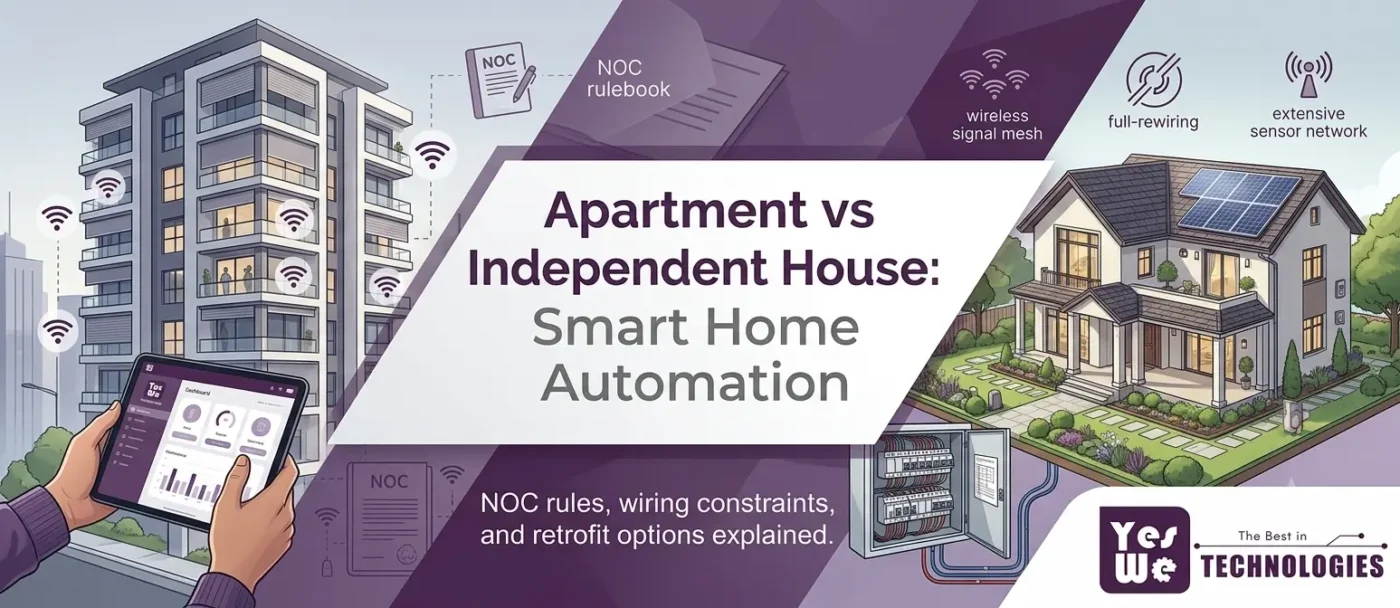
Take two families. Both in Bangalore, both with a similar budget for home automation, both wanting smart lighting, motorised curtains, a good home theatre, and a connected security system. One lives in a 3BHK apartment in a Prestige gated community in Whitefield. The other owns an independent house in Sarjapur Road.
Their automation journeys will look nothing like each other – not because of what they want, but because of what they own.
Property type is the single most underexplored variable in home automation planning in India. Most guides treat every home the same way: pick your devices, connect to Wi-Fi, you are done. The reality is that apartments and independent houses present fundamentally different constraints – in the wiring they come with, the permissions they require, the technologies that work, and the scope of automation that is possible.
This guide covers the real differences, in plain language, with specific context for Bangalore homes. Whether you are planning your first smart home upgrade or starting from scratch in a new property, understanding these differences before you spend a rupee is the most valuable thing you can do.
Key Takeaways
| 💡 In an apartment, you own the interior of your flat. The RWA owns the building structure, external walls, shafts, and common areas – and modifications to these require association approval. 💡 In an independent house, you own the structure, exterior, compound, and gate – giving you complete freedom within municipal bylaws. 💡 Most finished apartments in Bangalore were wired without a neutral wire at switch points, which limits which smart switches work and how automation is installed. 💡 External CCTV mounting, cable routing through building shafts, gate-level access control, and VDP at the building entrance all require RWA/builder permission in apartments. 💡 Wireless-first automation – modular touch switches, Zigbee devices, battery sensors, smart plugs – works in apartments without any permission or structural changes. 💡 Independent houses unlock wired backbone automation, gate automation, perimeter CCTV, outdoor speakers, and dedicated home theatre rooms that apartments structurally cannot support. 💡 The best time to plan automation in either property type is before interior work begins – but good retrofit options exist for finished homes in both categories. 💡 Yes We Technologies designs and installs smart home systems for both apartments and independent homes across Bangalore, with solutions matched to the actual constraints of each property type. |
The Ownership Boundary: The Concept That Changes Everything
Before comparing technologies or costs, you need to understand one foundational concept: what you actually own differs completely between an apartment and an independent house, and this difference determines what you can change, what needs approval, and what is simply off the table.
What You Own in a Gated Community Apartment
In a flat, your ownership extends to the air inside your unit – the interior space between your walls. The walls themselves, the building structure, the external facade, the electrical shafts running through the building, common-area fixtures, the building entrance, the compound, and the gate all belong to the Residents’ Welfare Association (RWA) or the builder, depending on whether the property is handed over.
Under the Karnataka Apartment Ownership Act, structural modifications require association approval. Any work that breaches a wall, routes a cable through a common shaft, mounts a fixture on an external surface, or modifies anything in a common area requires you to obtain permission from the RWA – in writing, before the work begins.
What You Own in an Independent House
In an independent house or villa, you own the structure from foundation to roof, the interior, the exterior walls, the compound, and the gate. You can drill, route cables, mount outdoor cameras, install a gate motor, lay conduit in your own driveway, and modify your electrical panel – all without seeking anyone’s approval, provided you comply with BBMP building bylaws and do not encroach on public land or shared infrastructure.
This is not a minor difference. It is the difference between having a smart home canvas versus having a smart home canvas with a significant portion already painted by someone else.
| Bangalore Context: Premium gated communities from Prestige, Brigade, Sobha, Godrej, and Puravankara often have community-level automation already installed – boom barriers, visitor management, common-area lighting, and building-entry VDP systems. These are RWA-managed and cannot be replaced by individual residents, but most can be integrated with your unit-level home automation system. |
NOC and RWA Permissions: What Requires Approval in Apartments
This is the section most home automation guides skip entirely. Knowing what requires RWA approval – and what does not – helps you plan intelligently and avoids the frustrating situation of having installation work stopped mid-way.
What Does NOT Require RWA Permission
The good news is that a large portion of meaningful home automation can be done entirely within your flat without any approval:
- Modular touch switches and retrofit modules installed behind existing switchboards
- Wireless smart devices – Zigbee bulbs, smart plugs, Wi-Fi switches, motion sensors, door sensors
- Battery-powered wireless sensors placed anywhere inside the flat
- Smart air conditioning control via IR blasters or Wi-Fi-enabled AC units
- Motorised curtains retrofitted to existing track systems inside your flat
- Interior wireless CCTV cameras placed inside your unit
- Smart door locks installed on your flat’s main door (your door, your lock)
- Home theatre and AV equipment installed inside the flat
- Smart lighting controlled from app or voice, using existing wiring
What DOES Require RWA or Builder Permission
These are the categories where apartments hit a genuine wall – sometimes literally:
- External CCTV cameras: Mounting a camera on an external wall, above your doorway in the corridor, or covering the common stairwell requires RWA approval. The external wall and corridor are common property.
- Cable routing through building shafts: Running a new cable through the electrical or conduit shafts that run vertically through the building requires the RWA’s consent, since these shafts serve all residents and any modification affects the entire riser.
- Video door phone at the building entrance: The building-level VDP, intercom panel, and access control at the lobby or gate are common infrastructure. Individual residents cannot replace or modify these without association approval – though most premium communities allow integration with your unit-level VDP.
- Gate automation and boom barriers: The community gate and parking barriers are common-area infrastructure managed by the RWA. Individual residents cannot install independent gate motors at a gated community entrance.
- Outdoor lighting on external walls or balcony soffits: Fixture mounting on external walls or common areas requires approval. Balcony lighting within your own balcony space is generally acceptable.
Practical Approach to RWA Permissions
When you need RWA approval, the process goes more smoothly if you propose reversible installations (nothing that permanently alters the structure), provide the technical specification of what you are installing and why it benefits the community or does not harm it, and get written approval before any work begins. Many RWAs in Bangalore’s premium communities are increasingly familiar with home automation requests and are open to reasonable proposals.
Wiring Constraints: The Technical Reality by Property Type
Beyond permissions, the wiring infrastructure you inherit with your property is the biggest technical determinant of how your smart home is built. And this is where apartments and independent houses diverge most sharply.
The Neutral Wire Problem in Apartments
Most apartments in Bangalore – particularly those built before 2015, and many built after – were wired using a looped wiring method. In this system, only a live wire and a switched-live wire run to each switch point. No neutral wire reaches the switches.
This matters because most smart switches and touch switch panels require a neutral wire to power their electronics continuously. Without it, your options narrow to: no-neutral smart switches (available, but with limited features and some LED flickering issues), retrofit relay modules placed near the distribution board rather than at the switch (works, but requires a different installation approach), or wireless devices that require no switch-point power at all.
If your apartment was wired with a neutral at every switch point – which some newer premium developments do specify – you have full compatibility with any smart switch on the market. An electrician can confirm this in about ten minutes.
Fixed Conduit Paths in Apartments
The conduit paths that run inside your apartment walls were fixed at the construction stage. In a finished flat, running a new cable between two rooms requires either routing it through an existing conduit (if there is space) or surface-mounting the cable in a cable channel along the wall or ceiling. Breaking a wall to route new conduit is technically possible but requires RWA approval if any common wall is involved, and is expensive enough to be worth avoiding for most automation requirements.
The practical implication: wireless is the default technology choice for apartments, not because it is necessarily superior, but because the wiring infrastructure usually makes a full wired backbone impractical after the fact.
What Independent Houses Have That Apartments Do Not
An independent house or villa gives you complete control over your electrical infrastructure – both what was installed and what you can change:
- If you are building or renovating, you can instruct your electrician to pull a neutral wire to every switch point in the house – a one-time decision that future-proofs the entire electrical infrastructure for any smart switch
- Wall access is yours – new conduit paths can be planned and routed during renovation without needing anyone’s permission
- Your electrical distribution board is your own – dedicated circuits for heavy loads, automation controllers, and home theatre equipment can all be planned independently
- Ceiling access is complete – in-ceiling speakers, hidden projector mounts, recessed lighting, and false ceiling automation provisions can all be incorporated at the construction or renovation stage
- External walls and compound are yours – outdoor cabling for CCTV, gate automation, outdoor speakers, and garden lighting can be routed cleanly through surface conduit or buried underground
What Each Property Type Can and Cannot Support
Here is the definitive breakdown – what is possible, what needs permission, and what is simply not available based on your property type.
| Automation Feature | Apartment | Independent House |
|---|---|---|
| Smart touch switches (retrofit) | Yes, no permission needed | Yes, no permission needed |
| Wireless smart lighting (Zigbee/Wi-Fi) | Yes, fully | Yes, fully |
| Wired smart lighting backbone (KNX/DALI) | Only at under-construction stage | Any stage during renovation or build |
| HVAC automation (smart AC, scheduling) | Yes, via IR or Wi-Fi AC | Yes, including central HVAC systems |
| Motorised curtains (existing track) | Yes, fully within the flat | Yes, plus full architectural track options |
| Interior CCTV cameras (wireless) | Yes, no permission needed | Yes, fully |
| Exterior CCTV cameras | Requires RWA permission | Full freedom, no permission needed |
| Smart door lock (main flat door) | Yes, fully | Yes, fully |
| Gate automation | Not applicable (community gate) | Full swing/sliding/telescopic options |
| Video door phone (unit level) | Yes, within flat door | Full custom VDP installation |
| In-ceiling speakers | Possible with false ceiling work | Fully achievable at any stage |
| Dedicated home theatre room | Rare – living room setup standard | Dedicated room fully achievable |
| Home automation gateway/hub | Yes, no permission needed | Yes, fully |
| Outdoor lighting automation | External walls need RWA permission | Full freedom |
| Perimeter and boundary security | Depends on RWA common system | Complete, independent control |
| Whole-home wired automation (premium) | Not practical in a finished flat | Achievable with proper planning |
The Best Time to Automate – and How It Differs by Property Type
Timing matters more in home automation than in almost any other home upgrade. The right time to plan is always before interior work begins – but the implications differ significantly between property types.
Apartments – Under Construction or Just Handed Over
If you receive possession of a new flat before interior work begins, this is the optimal window. You can ask the builder’s electrical contractor or your own electrician to pull a neutral wire to every switch point during first fix – a small addition that costs almost nothing at this stage and unlocks full smart switch compatibility for the life of the flat.
This is also the time to plan false ceiling provisions for any ceiling-mounted equipment: in-ceiling speakers, a ceiling-mounted projector, recessed smart lighting, or motorised screen mounting. Once the false ceiling is closed, these require reopening.
Yes We Technologies regularly works with homeowners at the handover stage in apartment communities across Whitefield, Koramangala, Sarjapur Road, and Hebbal – advising on electrical provisions before interior work begins, so that the home automation system in Bangalore is built on the right foundation from day one.
Apartments – Finished and Occupied
If your flat is already furnished and you are retrofitting, the approach is wireless-first. This is not a compromise – modern wireless automation for a finished apartment delivers excellent results:
- Modular touch switches or retrofit relay modules behind existing switchboards for light and fan control
- Zigbee or Wi-Fi smart bulbs where touch switch retrofitting is complex
- Smart AC control via IR blasters or Wi-Fi-enabled units
Motorised curtains on existing tracks – curtain automation in Bangalore is one of the most retrofit-friendly upgrades available for finished apartments
- Wireless CCTV cameras inside the flat for interior security
- Smart door lock on the main flat door
- A gateway/hub to connect all devices into a single system with scenes and voice control
Independent Houses – Under Construction
This is the best possible automation scenario. Every smart home provision costs a fraction of what it costs to retrofit, and nothing needs to be compromised. The priorities at this stage:
- Instruct the electrician to pull a neutral wire to every switch point as a standard specification
- Plan dedicated conduit paths for each system: lighting control, audio, security cameras, networking, home theatre
- Route conduit for gate motor power and control cable before the driveway is laid
- Plan outdoor CCTV cabling runs from each camera location back to the NVR location
- Include home theatre room provisions: projector mount point, screen housing, in-ceiling speaker conduit, acoustic panel mounting points
Coordinate the automation plan with your interior designer and civil contractor – all provisions for motorised gate automation in Bangalore, in-ceiling speakers, and wired security should be determined before walls are plastered and flooring is laid.
Independent Houses – Finished
A finished independent house still has significantly more flexibility than a finished apartment. You own the exterior and the compound, so all outdoor automation – gate, external CCTV, outdoor lighting, garden automation – remains fully accessible. Interior work may require surface conduit in some areas, but renovation access is available to you without seeking anyone’s permission.
Most independent homes in Bangalore’s older residential areas – Jayanagar, Banashankari, Indiranagar, JP Nagar – were wired without neutrals at switch points, since the same looped wiring method used in apartments was standard practice. The neutral wire check applies equally here. Where rewiring is not desired, the same wireless-first retrofit approach used in apartments applies to interior spaces, while outdoor automation remains unconstrained.
Smart Home Automation in Bangalore: Yes We Technologies
The approach to smart home automation changes fundamentally depending on whether you are in an apartment or an independent house – and even within each property type, your specific situation (wiring, handover stage, NOC status, RWA rules) determines what the right system looks like.
Yes We Technologies designs and installs home automation systems across both property types throughout Bangalore – from wireless-first retrofit setups in furnished apartments in Whitefield and Koramangala, to full wired backbone automation in villas under construction in Sarjapur Road and Hebbal, to independent houses at any stage of completion in Indiranagar, Jayanagar, JP Nagar, and Banashankari.
Every project starts with a free site visit that covers your property type, existing wiring, handover stage, and what you want the system to do – and results in a clear, honest recommendation on what is actually achievable, what it costs, and what the right sequence is.
Explore the full range of home automation solutions in Bangalore – and see how the system comes together across lighting, security, curtains, AV, and access control, regardless of whether you are in a flat or an independent home.
What Yes We Technologies delivers for both property types:
For apartments: wireless-first retrofit automation, modular touch switch installation, smart curtains on existing tracks, smart locks, interior CCTV, and full gateway-based scene integration – all without breaking walls or requiring RWA approval
For independent houses: full wired or hybrid automation, gate automation, perimeter CCTV, outdoor lighting, home theatre rooms, in-ceiling audio, and complete smart home integration from a single gateway
For under-construction properties: pre-build consultation and electrical specification so your automation provisions are built into the civil and electrical work rather than retrofitted into a finished space
Serving Whitefield, Indiranagar, Koramangala, Sarjapur Road, Hebbal, Electronic City, Jayanagar, Banashankari, JP Nagar, HSR Layout, Marathahalli, Bellandur, Devanahalli, and all areas across Bangalore.
| Book a Free Site Visit Phone: +91 9620555565 Email: enquiry@yeswe.in Address: #29, Opp. BESCOM, DLF Main Road, Bannerghatta Road, Hulimavu, Bengaluru – 560076 |
Frequently Asked Questions
1. Can I install home automation in a rented apartment in Bangalore?
Yes, with the right approach. Wireless devices, modular touch switches that retrofit into existing switch plates, smart plugs, battery-powered sensors, and smart door locks on your own door all work in rented apartments without any structural changes. These are reversible upgrades that can be removed when you vacate. Avoid any installation that breaches walls, routes cables through building shafts, or mounts fixtures on external walls without written RWA and landlord permission.
2. Do I need RWA permission for CCTV cameras in my apartment?
For cameras placed entirely inside your flat, no permission is needed. For cameras mounted on external walls, in the corridor outside your door, or covering any common area, RWA permission is required. The corridor, stairwells, and external building surfaces are common property under the Karnataka Apartment Ownership Act. Many RWAs will approve well-specified requests, particularly if you propose cameras that cover only your doorway and are cleanly installed.
3. What is the neutral wire problem and how does it affect smart home installation in apartments?
Most older apartment buildings in Bangalore were wired without a neutral wire at each switch point – only a live and switched-live wire reaches the switches. Most smart glass panel switches and touch switch boards require a neutral wire to power their electronics. Without it, you are limited to no-neutral compatible switches (available but with some limitations) or retrofit relay modules placed near the distribution board. An electrician can check whether your flat has neutral wires at the switch points in about ten minutes.
4. Can gate automation be installed in a gated community apartment?
No – the community gate and parking barriers are common infrastructure managed by the RWA and cannot be modified by individual residents. However, many premium gated communities in Bangalore already have automated boom barriers and RFID or number-plate recognition vehicle access that residents use. At the unit level, smart door locks, video door phones connected to your flat’s entry, and building-level VDP integration are all achievable without gate-level modifications.
5. What smart home features work best in a Bangalore apartment without any RWA permission?
A comprehensive and genuinely useful smart home is achievable entirely within your flat without any RWA permission. This includes smart touch switches or modular retrofit modules for all lights and fans, motorised curtains on existing tracks, smart AC control, wireless Zigbee or Wi-Fi lighting, smart door lock, interior wireless CCTV cameras, home theatre and AV integration, and a gateway connecting everything into a single app with scenes, scheduling, and voice control. This covers the great majority of what most households want from home automation.
6. Is it worth automating a rented apartment or should I wait until I own?
If you plan to stay in the apartment for two or more years, a wireless retrofit automation setup is worth it. Modern wireless systems are genuinely good, easily removable, and can often be reinstalled in your next home. Smart curtains, touch switches, smart locks, and a gateway-based lighting and scene system deliver daily convenience that improves quality of life from day one. The investment is modest compared to what a full wired system costs, and the daily benefit is substantial.
7. What is the best time to plan home automation for a new independent house in Bangalore?
Before the electrical first fix – ideally before walls are plastered. At this stage, your electrician can pull neutral wires to every switch point, route conduit for every system (lighting, AV, security, networking), plan the outdoor cabling for gate automation and perimeter CCTV, and provision mounting points for in-ceiling speakers and projectors. This single conversation with your electrical contractor, guided by Yes We Technologies, costs a fraction of what the same provisions cost to retrofit into a finished home.
8. How does the cost of home automation compare between apartments and independent houses in Bangalore?
For equivalent interior automation coverage, the cost is broadly similar – smart touch switches, curtain automation, smart lighting, and a gateway cost roughly the same regardless of property type. Independent houses carry additional scope: gate automation, outdoor CCTV, perimeter lighting, and possibly a dedicated home theatre room – these add to the total but are not available to apartments at all. At the under-construction stage, an independent house offers significantly lower installation cost per feature because provisions can be built into the civil and electrical work rather than retrofitted.