

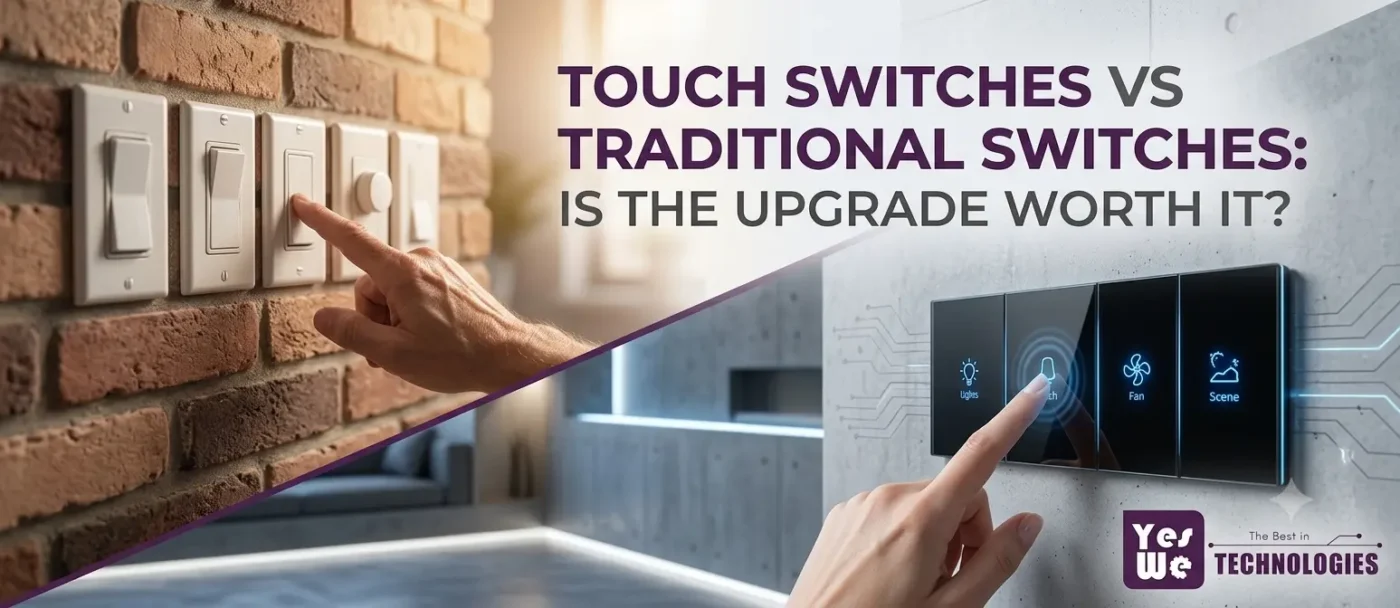
You have seen them in a friend’s apartment, a hotel lobby, or a newly built flat — sleek glass panels where a row of plastic switches used to be. They look sharp. They feel different. And they make you wonder whether your own home’s switchboard looks ten years out of date.
That is the version of this question most blog posts answer with an enthusiastic ‘yes, here are six reasons to upgrade.’ This is not that blog post.
Touch switches are a genuinely good upgrade for many homes in Bangalore — but not every home, not every room, and not always right now. The honest answer depends on your wiring, your budget, how you use your home, and what you actually want from the upgrade. This guide gives you that honest answer.
Key Takeaways
| 💡 Touch switches use capacitive sensors with no mechanical parts — no wear, no sparking, safe with damp hands. 💡 Two distinct types exist: modular touch (retrofit into existing plates) and glass panel smart switches (full board replacement). They are different products at different price points. 💡 The safety advantage in Indian conditions — moisture resistance, shock-proof surface — is real and underrated. 💡 Smart features (voice control, scenes, scheduling) require Wi-Fi; if the connection drops, app and voice control stop but basic touch on/off still works. 💡 Older Indian homes without a neutral wire at switch points need an electrician to assess compatibility before buying. 💡 India pricing: modular touch Rs 500 to Rs 2,500 per module; glass panel smart boards Rs 2,500 to Rs 30,000 per panel. 💡 The upgrade makes the most sense during renovation or new builds — retrofitting to an existing home works but costs more. 💡 Start with living rooms, master bedrooms, and kitchens — not every switch in the house needs to change at once. |
What Actually Makes a Touch Switch Different
Before comparing them, it helps to understand what separates these two technologies at the level of how they work — because that difference explains most of the practical advantages and limitations.
Traditional Switches: Mechanical Operation
A traditional switch works by physically breaking or completing an electrical circuit. When you flip the lever, a set of metal contacts inside either touch (completing the circuit, turning on the load) or separate (breaking the circuit, turning it off). This mechanical contact is what causes the familiar click, and it is also what wears out over time. Metal contacts corrode, springs weaken, and eventually the switch either sticks or fails to make contact reliably.
Touch Switches: Capacitive Sensing
A touch switch has no moving parts inside. Instead, it uses a capacitive sensor — the same technology used in your smartphone screen — embedded behind a glass or acrylic surface. When your finger touches the panel, the sensor detects a change in the electrical field caused by your body’s capacitance, and sends a signal to the electronics behind it to switch the load on or off.
Because nothing physically moves when you touch it, there is nothing to wear out mechanically. There is no metal contact, no spring, no lever. The response on day one and day two thousand is identical.
Two Different Products Under the Same Name
This is the distinction most buyers miss when they start researching, and it causes a lot of confusion:
| Type | What it is | Price range | Best for |
|---|---|---|---|
| Modular touch switch | Replaces the switch module inside an existing modular plate | Rs 500 to Rs 2,500 per module | Retrofit into existing homes, budget-conscious upgrade |
| Glass panel smart switch | Replaces the entire switchboard with a single glass panel | Rs 2,500 to Rs 30,000 per panel | New builds, full renovations, smart home integration |
Modular touch switches fit into the standard electrical box and plate frames already on your wall — no rewiring, no wall damage. Glass panel smart switches replace the entire assembly and typically offer more features: scene control, dimming, fan speed regulation, app and voice control, and scheduling. They cost more and usually need a professional to install correctly.
The Real Advantages — and Which Ones Actually Matter
Every brand selling touch switches will give you a list of benefits. The question worth asking is: which of these advantages translate into genuine daily value, and which are marketing points that sound impressive but rarely come up in practice?
Safety in Indian Conditions — This One Is Real
Indian homes deal with humidity, dust, and voltage fluctuations that most global electrical standards do not plan for. Traditional mechanical switches can spark at the internal contacts when power fluctuates or when the contacts begin to corrode — a genuine fire risk, particularly in older buildings.
Touch switches have no internal metal contacts that can corrode or spark. The glass surface has no direct electrical exposure. You can operate them with wet hands in the kitchen or bathroom without any risk of shock — something you would never do with a traditional switch. In Bangalore’s monsoon months, when humidity is high and condensation is common in bathrooms and utility areas, this is a practical daily safety advantage, not a marketing claim.
Aesthetics — More Impactful Than People Admit
A flat glass panel flush with the wall, backlit with soft icons, genuinely transforms the look of a room. If you have invested in good flooring, quality paint, and modern furniture, plastic toggle switches are a visible inconsistency. This is not a superficial concern — interior design coherence has a real effect on how a home feels. The aesthetic upgrade is one of the most immediately visible returns on the investment.
Smart Features That Earn Their Place Daily
- Dimming and fan speed control: Being able to set your living room lights to 40 percent for a movie and your bedroom fan to speed 2 without getting up — from the same glass panel — is a genuinely useful daily convenience.
- Scene control: One tap activates ‘Good Night’ — bedroom light off, living room off, bathroom night light on. Or ‘Morning’ — bedroom light on at 30 percent, fan off. Scenes eliminate the habit of walking around turning things off individually.
- Remote access: Left the lights on before leaving the house? Turn them off from your phone. Forgot to switch off the geyser? Done from the office. This is the feature that converts sceptics once they have lived with it for a week.
- Voice control: Works well when your hands are full, when you are in bed, or when elderly family members find the app less intuitive. ‘Alexa, turn off the bedroom lights’ requires zero physical movement.
- Scheduling: Outdoor lights that turn on at sunset and off at midnight. Geyser that switches on at 6 AM and off at 6:30 AM. These small automations add up to meaningful electricity savings and one less thing to remember.
Features That Sound Impressive but Matter Less
- Energy monitoring: Available on premium panels. Genuinely useful only if you actively check the data and change behaviour. Most households look at it for the first month and then forget it exists.
- Resale value uplift: Real, but modest. Buyers notice and appreciate it, but it is rarely the deciding factor in a purchase decision. Do not buy touch switches primarily for resale value.
The Honest Drawbacks — What Competitors Will Not Tell You
This section is the one you will not find on any brand’s website. Read it before you decide.
Higher Upfront Cost
There is no getting around this. A traditional modular switch costs Rs 80 to Rs 400. A modular touch switch costs Rs 500 to Rs 2,500. A glass panel smart switch board costs Rs 2,500 to Rs 30,000. For a 3BHK apartment with 25 to 30 switch points, a full glass panel replacement can run Rs 1,50,000 to Rs 3,00,000 or more, including professional installation. That is a real number and it deserves honest acknowledgement.
The Neutral Wire Problem
This is the most important technical limitation for older Indian homes, and almost nobody writes about it clearly. Most smart touch switches require a neutral wire at the switch point to power the electronics inside the panel. Older Indian homes — typically built before 2005 — were wired with only a live wire looped through the switch points. No neutral was brought to the switches.
If your home does not have a neutral wire at the switch, you either need to run new wiring (a significant electrical job) or buy a specific no-neutral smart switch (available but with fewer features and some limitations). Before buying any smart switch, have an electrician confirm your wiring type.
Internet and Power Dependency for Smart Features
The basic on/off function of a touch switch works without Wi-Fi — you touch the panel and the load switches. But the smart features — app control, voice commands, scheduling, scenes — depend on your Wi-Fi network. If the router goes down, those features stop working until connectivity is restored. In a power cut, smart switches that require a neutral wire go completely offline. Basic touch on/off returns when power is restored, but the switch cannot operate anything if the load it controls also has no power.
This is not a dealbreaker. It is simply the reality of any networked device. Understanding it prevents disappointment.
Not Every Room Benefits Equally
A touch switch in your living room, master bedroom, and kitchen makes daily sense. A touch switch on a utility room light you use twice a week, or on an outdoor fixture in a dusty or physically exposed location, adds cost without proportional value. Traditional switches remain the more practical choice in utility areas, garages, and outdoor exposed points.
Learning Curve for Elderly Family Members
Most manufacturers claim touch switches are easier for elderly users. For some, that is true — feather-touch is gentler than a stiff lever. For others, the absence of tactile feedback (no click confirmation), backlit icons they are not used to, and app-based controls are genuinely confusing. If your home has elderly residents who are not comfortable with touchscreen devices, factor this in. Voice control partially solves it, but requires its own setup and familiarity.
What Does the Upgrade Actually Cost in Bangalore?
| Switch type | Per unit / panel | Typical 3BHK estimate |
|---|---|---|
| Traditional modular switch | Rs 80 to Rs 400 | Rs 3,000 to Rs 15,000 (full home) |
| Modular touch switch (retrofit) | Rs 500 to Rs 2,500 | Rs 15,000 to Rs 60,000 (full home) |
| Glass panel smart switch (basic) | Rs 2,500 to Rs 6,000 | Rs 60,000 to Rs 1,50,000 (full home) |
| Glass panel smart switch (premium) | Rs 8,000 to Rs 30,000 | Rs 2,00,000 to Rs 5,00,000+ (full home) |
Professional installation for glass panel smart switches typically costs Rs 500 to Rs 1,500 per point, depending on wiring complexity and whether neutral wires are already in place. Modular touch switches can usually be swapped in by any electrician familiar with standard modular fittings.
The Smarter Way to Budget This
You do not have to replace every switch at once. The most practical approach for existing homes in Bangalore is a phased upgrade:
- Phase 1 — High-visibility, high-use rooms: living room, master bedroom, kitchen. These give the biggest daily return and the most visible aesthetic impact.
- Phase 2 — Secondary bedrooms and bathrooms, where the safety advantage of wet-hand-safe surfaces adds ongoing value.
- Phase 3 — Full integration: connect remaining switches, add scene programming, voice assistant setup, and smart home integration.
This approach distributes the cost over time and lets you learn which features you actually use before committing to a full-home installation.
Touch Switches as Part of a Wider Home Automation System
A touch switch in isolation replaces one behaviour — flipping a lever — with a slightly better one. Connected to a wider home automation system, it becomes something meaningfully different.
When smart touch switches are integrated with your lighting, HVAC, AV, and security systems, a single panel or a single voice command can trigger a coordinated response across the whole room or whole home:
- Movie Mode: One tap dims all lights to 10 percent, closes motorised curtains, sets the AC to your viewing temperature, and powers on the AV system.
- Good Morning: Lights ramp up gradually at 6:30 AM, geyser switches on, AC transitions from night to morning setting — all from a single scheduled scene.
- Leave Home: All lights off, AC off, geyser off, security system armed — confirmed from your phone before you reach the lift.
This level of integration is what smart touch switches are designed for when they are part of a complete home automation system in Bangalore. A glass panel smart switch installed in isolation delivers convenience. The same switch installed as part of a planned automation system — with motorised curtains, smart lighting, and HVAC control — delivers a fundamentally different daily experience.
If the living room scene involves dimming and tuning your lights to the right colour temperature, that connects naturally to smart lighting solutions in Bangalore — where dimmable and tunable lighting is designed to work alongside touch switch scenes from day one.
Should You Upgrade? The Honest Decision Framework
Here is the direct answer to the title question — for different situations.
| Your situation | Verdict | Reason |
|---|---|---|
| Building a new home or doing a full renovation | Yes — do it now | Cleanest installation, neutral wire planned from the start, no retrofitting cost |
| Existing owned home with good Wi-Fi and modern wiring | Yes — strong value | Modular touch or glass panel works well; start with living room and master bedroom |
| Existing home, older wiring (pre-2005 construction) | Get an electrician assessment first | Neutral wire availability at switch points must be confirmed before buying anything |
| Rented apartment | Modular touch only | Glass panels require commitment; modular touch switches are retrofit-friendly and reversible |
| Total budget under Rs 10,000 for the whole home | Not yet | Do one room well rather than all rooms poorly; save and phase the upgrade |
| Home with elderly residents unfamiliar with tech | Modular touch with voice control | Gentler than a lever for arthritic hands; voice control removes the app dependency |
| Utility areas, outdoor switches, garages | Keep traditional | Cost without proportional value; traditional switches are more practical in these areas |
The short version: if you own your home, have reasonable wiring, and are willing to invest in doing it properly — starting with two or three rooms — the upgrade is worth it. If you are in a rental, working with a tight budget, or have wiring you have not checked, slow down and assess before buying.
Smart Touch Switch Installation in Bangalore — Yes We Technologies
Yes We Technologies installs smart touch switches in Bangalore for apartments, independent homes, villas, and commercial spaces — from a single-room modular upgrade to a full glass panel smart switch system integrated with home automation, lighting control, and voice assistants.
Our approach starts with a free site visit that covers wiring compatibility (including neutral wire availability), panel selection based on your home’s layout and budget, and integration planning if you want the switches to be part of a wider home automation system in Bangalore. We recommend the right tier for each room rather than selling the most expensive option across the whole home.
What Yes We Technologies delivers:
- Modular touch switch retrofits — no wall damage, works with existing wiring in most cases
- Glass panel smart switch boards — Alexa, Google Assistant, app control, scene programming
Additional read 👉 Smart Lighting Systems: How They Enhance Mood and Productivity
Dimming, fan speed control, and tunable lighting integration — linked to smart lighting in Bangalore for complete room-level light scene control
- Full smart home scene setup: Movie Mode, Good Morning, Leave Home, and custom scenes
- Integration with motorised curtains, HVAC, AV, CCTV, and security systems
- After-sales support and Annual Maintenance Contracts
Serving Whitefield, Indiranagar, Koramangala, Sarjapur Road, Hebbal, Electronic City, Jayanagar, Banashankari, JP Nagar, HSR Layout, and all areas across Bangalore.
| Book a Free Site Visit — Yes We Technologies Visit — Smart Touch Switches Phone: +91 9620555565 Email: enquiry@yeswe.in Address: #29, Opp. BESCOM, DLF Main Road, Bannerghatta Road, Hulimavu, Bengaluru – 560076 |
Frequently Asked Questions
1. What is the main difference between a touch switch and a traditional switch?
A traditional switch works by physically breaking or completing a circuit through a mechanical lever and metal contacts. A touch switch uses a capacitive sensor — no moving parts — to detect your touch and electronically switch the load. The result is no mechanical wear, no sparking at contacts, and a flat glass surface that is safe to use with damp hands.
2. Do touch switches work without Wi-Fi or internet?
The basic touch on/off function works without Wi-Fi — you touch the panel and the load switches, just like a traditional switch. Smart features — app control, voice commands, scheduling, and scenes — require a Wi-Fi connection to function. If your router goes down, those features are unavailable until connectivity is restored, but the physical touch switch continues to work normally.
3. Can touch switches be installed in an existing home without rewiring?
Modular touch switches typically can, as they fit into existing modular plate frames without new wiring in most cases. Glass panel smart switches often require a neutral wire at the switch point, which older Indian homes (typically pre-2005 construction) may not have routed to the switches. An electrician needs to confirm neutral wire availability before you buy a glass panel smart switch for an existing home.
4. How much do touch switches cost in Bangalore?
Modular touch switches cost Rs 500 to Rs 2,500 per module and are the more affordable retrofit option. Glass panel smart switch boards cost Rs 2,500 to Rs 30,000 per panel depending on features and brand. For a full 3BHK home upgrade to glass panel smart switches, budget Rs 1,50,000 to Rs 3,00,000 including professional installation. A phased approach — starting with two to three key rooms — is the most practical way to manage costs.
5. Are touch switches safe to use with wet hands?
Yes — this is one of their genuine advantages over traditional switches. The glass or acrylic surface has no direct electrical exposure, and quality touch switches are designed to be moisture-resistant. You can operate them in kitchens and bathrooms with damp hands without any shock risk, which is a meaningful safety improvement over traditional mechanical switches where water ingress can cause sparking or shock.
6. Can touch switches be integrated with Alexa or Google Home?
Yes, most Wi-Fi-enabled smart touch switches support Alexa and Google Assistant out of the box. Once configured, you can control lights, fans, and appliances by voice — ‘Alexa, turn off the living room lights’ or ‘Hey Google, good night.’ Zigbee-based switches work with Alexa through a compatible hub. Basic modular touch switches without Wi-Fi do not support voice control.
7. What are the drawbacks of touch switches that brands do not mention?
The main ones are: higher upfront cost than traditional switches; dependency on a neutral wire that older Indian homes may not have at switch points; smart features going offline if Wi-Fi drops (basic on/off still works); limited benefit in utility areas, garages, and outdoor exposed locations; and a potential learning curve for elderly residents unfamiliar with touch interfaces or app-based controls.
8. Do touch switches increase property resale value?
Yes, modestly. Buyers notice the upgrade and it contributes to a premium perception of the property — particularly in Bangalore’s competitive apartment market in areas like Whitefield, Koramangala, and Sarjapur Road. The uplift is real but modest, and should be considered a secondary benefit rather than the primary reason to upgrade. The primary returns are daily convenience, safety, and aesthetics.