

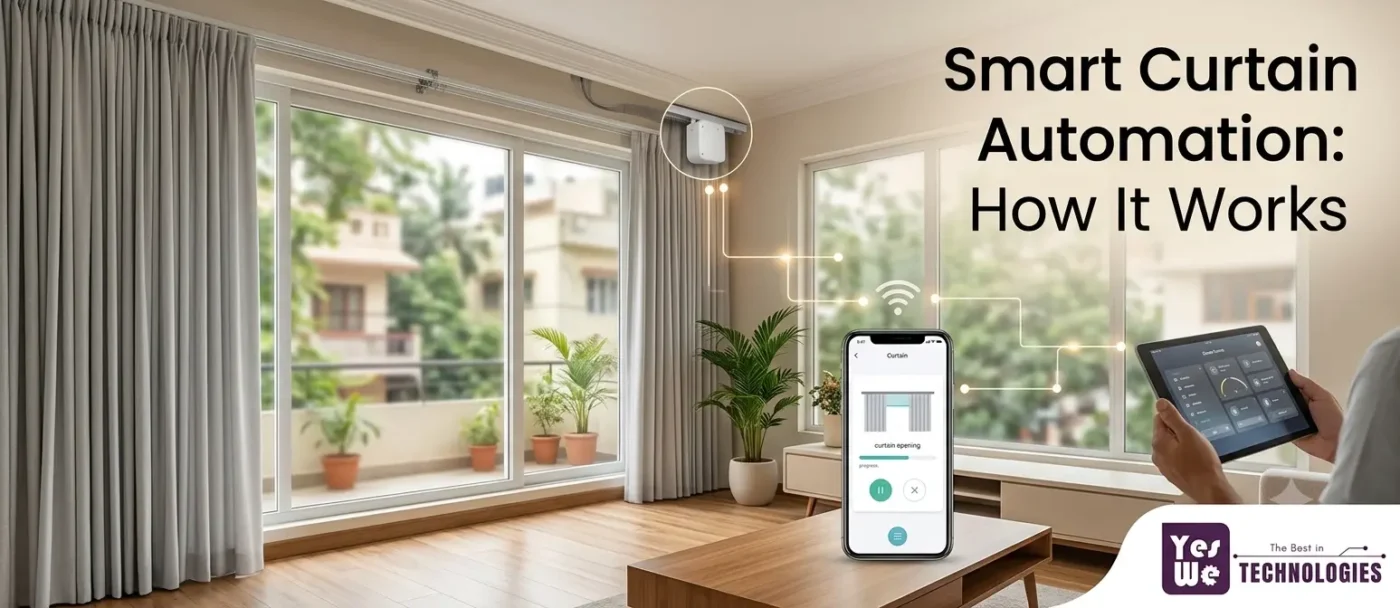
Picture a typical Bangalore afternoon in March. Sun hammering through west-facing windows, the AC working overtime, and the curtains still wide open because nobody got around to closing them before leaving for work. By 7 PM when you get home, the living room has turned into a greenhouse.
This is exactly the kind of daily frustration smart curtain automation is built to solve — not in a gimmicky technology way, but in a practical, life-quality way. Curtains that close themselves on a schedule, respond to a voice command, and slot into scenes that dim your lights and fire up your home theatre without you lifting a finger.
This guide covers how smart curtain automation in Bangalore actually works, what you need to know before buying, and what it realistically costs. No fluff, no overselling — just the information you need to make a good decision.
Key Takeaways
| 💡 Smart curtains replace the pull-cord with a silent motor controlled by app, voice, remote, or schedule. 💡 Track type (I-rail, U-rail, or round rod) and curtain weight are the two things you must confirm before buying any motor. 💡 Wired motors handle heavy Indian blackout curtains better; battery motors suit lighter fabrics in rented apartments. 💡 Full cost in Bangalore: Rs 2,000 to Rs 4,000 per window for installation; motor hardware costs Rs 4,000 to Rs 15,000+ separately. 💡 Smart curtains integrate with Alexa, Google Home, and scenes like Morning Routine and Movie Mode. 💡 Scheduling curtains to close during Bangalore’s afternoon heat peak (12 PM to 4 PM) reduces solar heat gain and lowers AC load. |
How Smart Curtain Automation Actually Works
The mechanism is simpler than most people expect. A motor replaces the manual pull-ring on your existing curtain track. When the motor receives a command — from an app, a voice assistant, a wall remote, a time schedule, or an automation trigger — it moves the curtain smoothly along the track, then stops. That is the whole system.
What makes it smart is how that command gets there. You can control your curtains through any of these methods:
- Mobile app — open, close, or set to any position, from inside the room or across the city
- Voice command — ‘Alexa, close the bedroom curtains’ or ‘Hey Google, open the living room blinds’
- Wall remote or panel — a button near the door, no phone needed
- Time schedule — curtains open at 7 AM and close at noon, every day, automatically
- Automation trigger — curtains close when a light sensor detects afternoon sun intensity, or when you activate a Movie Mode scene
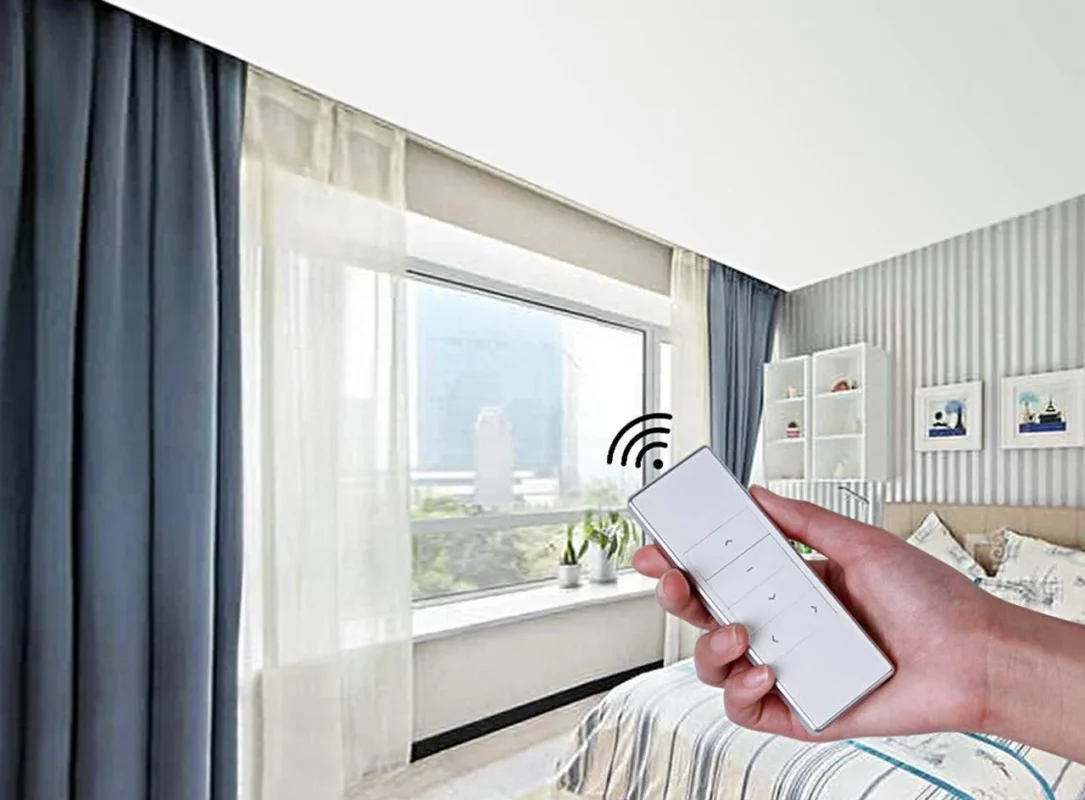
Protocols: Wi-Fi, Zigbee, and Bluetooth
The protocol is how the motor communicates with your phone or smart home system. Most buyers skip this detail and later find their motor does not integrate the way they expected. Here is the practical difference:
| Protocol | Connects to | Hub needed? | Best for |
|---|---|---|---|
| Wi-Fi | Your home router directly | No | Simple setups, quick install, standalone use |
| Zigbee | A Zigbee hub (Aqara, Tuya, etc.) | Yes | Full smart home scenes with lighting, HVAC, AV |
| Bluetooth | Your phone directly | No, but limited range | Battery motors, rentals, single-room use |
Wi-Fi motors are the easiest to get started with — no hub, no extra setup. Zigbee motors cost a bit more upfront but work far better when curtains are part of larger automation scenes. Bluetooth is fine for one room but impractical at a whole-home scale.
Motorised Curtain Tracks vs Roller Blind Motors
These are two completely different products, not interchangeable. A motorised curtain track motor moves hanging curtain panels along an I-rail or U-rail. A roller blind motor sits inside the blind tube and rolls the fabric up and down. If you have hanging curtains, you need a curtain track motor. If you have roller blinds, you need a roller motor. This sounds obvious, but it is the most common ordering mistake — confirm which one you have before buying.
Track Type and Curtain Weight: Get These Right First
Most buyer problems in curtain automation come down to two things: picking a motor that cannot handle the curtain’s weight, or ordering one that is incompatible with the existing track. Both are easy to avoid with a ten-minute check before you buy anything.
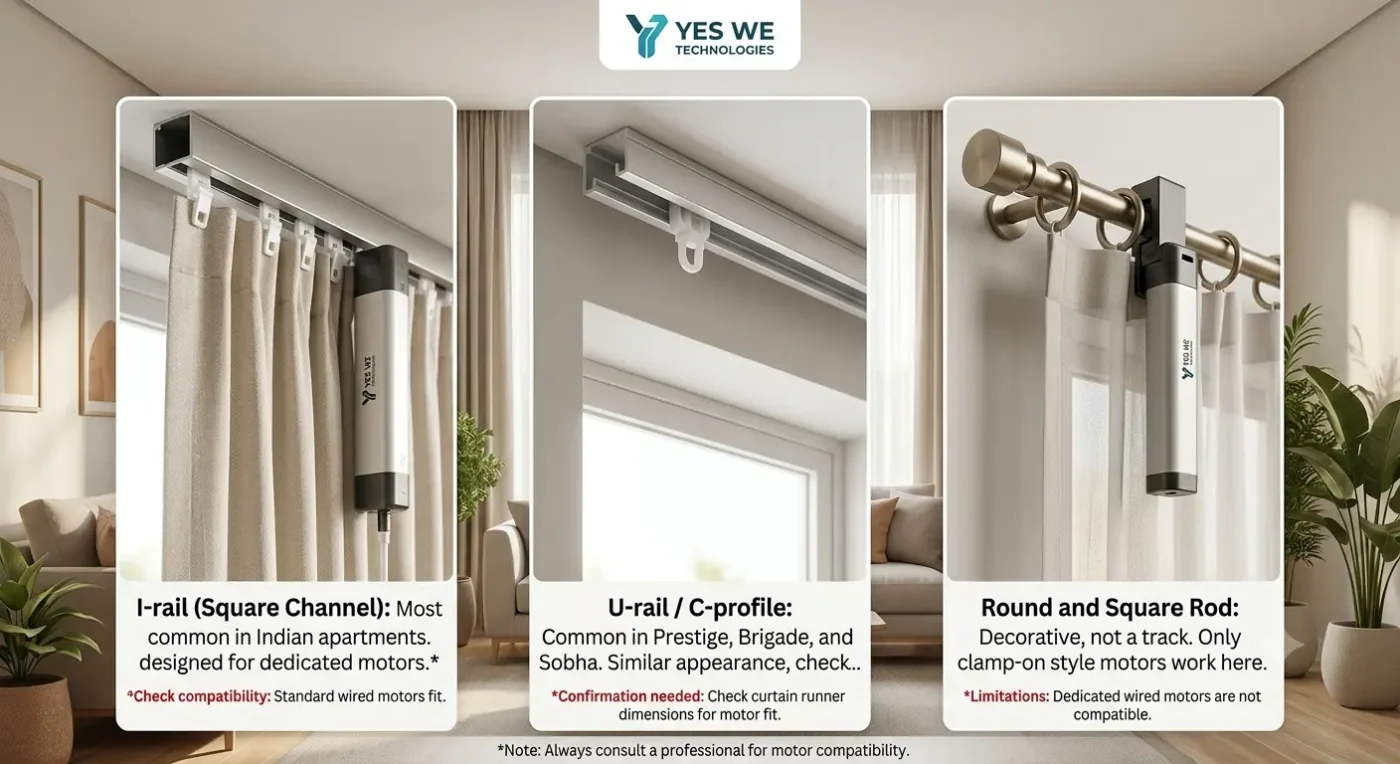
Know Your Track Type
- I-rail (square channel): The most common track type in Indian apartments. Most curtain motors are designed for this. If your curtains clip into a square cross-section channel, this is what you have.
- U-rail / C-profile: Common in Prestige, Brigade, and Sobha apartments. Visually similar to I-rail. Most I-rail motors are compatible, but confirm the curtain runner dimensions first.
- Round or square rod: A decorative rod, not a track. Only clip-on motors that clamp onto the rod work here. Standard wired motors with dedicated runners cannot be used on rods.
Curtain Weight Is the Variable Most People Miss
A standard battery-powered motor is typically rated for 8 to 12 kg. That is fine for sheer curtains or light linen drapes. But a heavy blackout curtain on a 3 to 4 metre track in an Indian apartment — the kind that actually blocks Bangalore’s afternoon sun — can weigh 20 to 30 kg. A battery motor will slip, stall, or fail under that load.
For heavy curtains, you need a wired motor rated 25 kg or more. This is not a minor technical footnote — it is the most consequential hardware decision in the whole purchase. Weigh your curtains on a kitchen scale before you shortlist any motor.
Wired vs Battery Motor: Which One Fits Your Home?
| Wired Motor | Battery Motor | |
|---|---|---|
| Power source | 220V outlet near the track | Rechargeable battery (USB-C or proprietary) |
| Weight capacity | 25 to 30 kg and above | 8 to 12 kg (lighter curtains only) |
| Installation | Electrician needed for power point | DIY-friendly, no electrical work |
| Recharging | Not required — always on | Every 3 to 6 months depending on use frequency |
| Smart home integration | Excellent via Zigbee or Wi-Fi | Good via Bluetooth or Wi-Fi |
| Best for | Owned homes, heavy curtains, daily use | Rentals, light curtains, no-wire situations |
A hybrid approach works well in larger homes: wired motors in the living room and master bedroom where heavy blackout curtains are installed and daily automation matters most, and battery motors in guest rooms or study rooms where the curtains are lighter and installation simplicity is a priority.
What Smart Curtain Automation Costs in Bangalore
Budget for two separate components: the motor hardware and the installation labour. Most professional quotes bundle them, but understanding what each covers helps you evaluate quotes properly.
Installation Costs (Labour and Track Setup)
| Work type | Typical cost in Bangalore |
|---|---|
| Standard curtain rod installation | Rs 300 to Rs 600 per window |
| Ceiling-mounted track installation | Rs 600 to Rs 1,200 per window |
| Motorised curtain setup — labour only | Rs 2,000 to Rs 4,000 per window |
| Annual maintenance | Rs 2,500 to Rs 5,000 per year |
Motor Hardware Costs
| Motor tier | Price range |
|---|---|
| Entry-level Wi-Fi (generic Tuya-based) | Rs 3,000 to Rs 6,000 |
| Mid-range Zigbee or Wi-Fi (Aqara, Zemismart) | Rs 6,000 to Rs 10,000 |
| Premium wired motor with full integration (Somfy, GM) | Rs 10,000 to Rs 15,000+ |
Full Cost Per Window (Motor + Installation)
- Basic — battery motor, light curtains, minimal integration: Rs 8,000 to Rs 15,000
- Mid-range — wired motor, heavier curtains, professional install: Rs 15,000 to Rs 25,000
- Full smart home integrated system across multiple rooms: custom quote
Installing multiple windows in one visit typically reduces the per-window labour cost by 15 to 25 percent compared to doing them one at a time. If you have three or more windows to automate, do them all together.
What Drives the Cost Up
- Wider, heavier curtains requiring more powerful motors
- Concrete ceiling drilling for new track installation
- Double-layer tracks (blackout and sheer on the same window)
- Smart home protocol choice — Zigbee systems have a higher entry cost but lower long-term cost than cloud-dependent Wi-Fi systems with ongoing subscription models
Where Smart Curtains Become Transformative: Scene Integration
A motor on its own is convenient. Curtains connected to a smart home system are something else. This is the part most guides skip, and it is where the real daily value comes from.
- Morning Routine: At 7 AM, curtains open 40 percent, lights ramp up gradually, and the AC shifts from night mode to morning mode. The room wakes up around you before your alarm goes off.
- Movie Mode: One tap closes all curtains, dims the lights to cinema level, powers on the TV and AV system, and sets the AC to your viewing temperature. Five seconds, zero effort.
- AC Efficiency Schedule: Curtains auto-close every day between 12 PM and 4 PM on south and west-facing windows during Bangalore’s hot months. Industry estimates suggest this reduces solar heat gain through glass by 20 to 40 percent, which directly lowers AC runtime and electricity cost.
- Leave Home: When the last person leaves and the alarm arms, curtains close automatically — keeping the interior cool and simulating occupancy.
These scenes require a Zigbee motor on a compatible hub, or a Wi-Fi motor integrated with Google Home or Amazon Alexa. Bluetooth-only motors handle standalone control well but cannot participate in multi-device scenes.
If you are planning curtain automation as part of a wider smart home setup, explore motorised curtain automation in Bangalore at Yes We Technologies to see how curtains connect with lighting, HVAC, and home theatre.
Before You Install: Four Things to Check
This takes ten minutes and prevents the most common and most expensive installation mistakes.
- Track type: Identify whether you have an I-rail, U-rail, round rod, or roller blind system. Take a photo and share it when requesting a quote — this one detail determines which motors are compatible with your setup.
- Curtain weight: Take the curtains down and weigh them, or estimate based on fabric and width. Heavy blackout drapes need wired motors rated 25 kg or more. If you skip this and order a battery motor for heavy curtains, you will need to replace it.
- Power access: For wired motors, confirm that a 220V point can be brought to within half a metre of the curtain track. In most apartments, this requires an electrician to assess ceiling or wall routing — something Yes We Technologies covers during the free site visit.
- Wi-Fi signal strength: Smart curtain motors need a stable wireless signal in every room where they are installed. Walk around with your phone and check the signal in each room. Weak coverage in a far bedroom is a common cause of connectivity issues and is best addressed before installation, not after.
Book a Free Site Visit with Yes We Technologies
Yes We Technologies provides motorised curtain automation in Bangalore for apartments, independent homes, villas, and commercial spaces — from a single window motor to a full multi-room smart home setup with scenes, voice control, and integration across lighting, HVAC, and AV systems.
The free site visit covers everything in one go: track assessment, curtain weight confirmation, motor recommendation, power access check, protocol recommendation, and a clear written quote. No obligation, and it takes about 30 to 45 minutes.
- Silent motorised curtain tracks compatible with most existing I-rail and U-rail systems
- Wired and battery motor options matched to your curtain weight and home situation
- Voice control via Amazon Alexa and Google Assistant
- Scene integration — Morning Routine, Movie Mode, Leave Home, and custom scenes
- Full smart home integration with lighting, HVAC, security, and AV
- After-sales support and Annual Maintenance Contracts
Serving Whitefield, Sarjapur Road, Koramangala, Indiranagar, Hebbal, Electronic City, Jayanagar, Banashankari, JP Nagar, HSR Layout, Bannerghatta Road, and all areas across Bangalore.
| Book a Free Site Visit — Yes We Technologies Website: www.yeswe.in Phone: +91 9620555565 Email: enquiry@yeswe.in Address: #29, Opp. BESCOM, DLF Main Road, Bannerghatta Road, Hulimavu, Bengaluru – 560076 |
Frequently Asked Questions
1. What is smart curtain automation and how does it work?
Smart curtain automation replaces the manual pull-cord on your curtain track with a silent electric motor. The motor moves the curtains open or closed when it receives a command from a mobile app, voice assistant, wall remote, time schedule, or automation trigger. The curtains themselves do not change — only the mechanism that moves them.
2. Can motorised curtains be installed on my existing track?
In most cases, yes. If you have an I-rail or U-rail track — the most common types in Indian apartments — the existing track can typically be reused and a motor added to it. Round rods require a different clip-on motor type. Roller blind systems are a separate product category. Confirming your track type before ordering is the single most important step.
3. Do smart curtain motors work with heavy blackout curtains?
Yes, but only with the right motor. Battery-powered motors are typically rated for 8 to 12 kg — suitable for sheers or lightweight drapes. Heavy blackout curtains on a 3 to 4 metre track can weigh 20 to 30 kg, which requires a wired motor rated 25 kg or above. Weigh your curtains before selecting a motor — this is the most consequential hardware decision in the process.
4. How much does motorised curtain installation cost in Bangalore?
Labour and track setup for motorised installation typically costs Rs 2,000 to Rs 4,000 per window. Motor hardware costs Rs 3,000 to Rs 15,000 or more depending on type and brand. A complete setup per window — motor plus installation — generally ranges from Rs 8,000 to Rs 25,000. Installing multiple windows together in a single visit reduces the per-window cost by 15 to 25 percent.
5. What is the difference between a wired and a battery curtain motor?
A wired motor draws power from a 220V outlet near the track, handles heavier curtains, and runs continuously with no recharging. A battery motor runs on a rechargeable internal battery that needs topping up every 3 to 6 months, requires no electrical work, and is ideal for rented apartments or rooms with lighter curtains.
6. Do automated curtains actually help reduce electricity bills?
They make a measurable difference in Bangalore’s climate. South and west-facing rooms experience significant solar heat gain in the afternoon, which forces the AC to work harder. Scheduling curtains to close during peak heat hours — 12 PM to 4 PM — reduces the amount of solar energy entering the room. Industry estimates suggest this can reduce solar heat gain through glass by 20 to 40 percent, which translates to lower AC runtime and electricity cost over a month.
7. Which smart home platforms work with motorised curtains?
Wi-Fi motors are compatible with Google Home, Amazon Alexa, and most Tuya-based smart home apps. Zigbee motors work with Aqara Hub, SmartThings, Home Assistant, and other Zigbee-compatible platforms, and offer the most reliable multi-device scene integration. Bluetooth motors work with dedicated apps and can connect to Alexa and Google through a hub bridge.
8. How long does curtain automation installation take?
For a standard apartment with two to four windows, installation is typically completed in two to four hours in a single visit. Larger homes with more windows, complex ceiling mounting, or full smart home integration may need a follow-up visit for system configuration and testing. Yes We Technologies provides a time estimate during the free site visit based on your specific scope.