

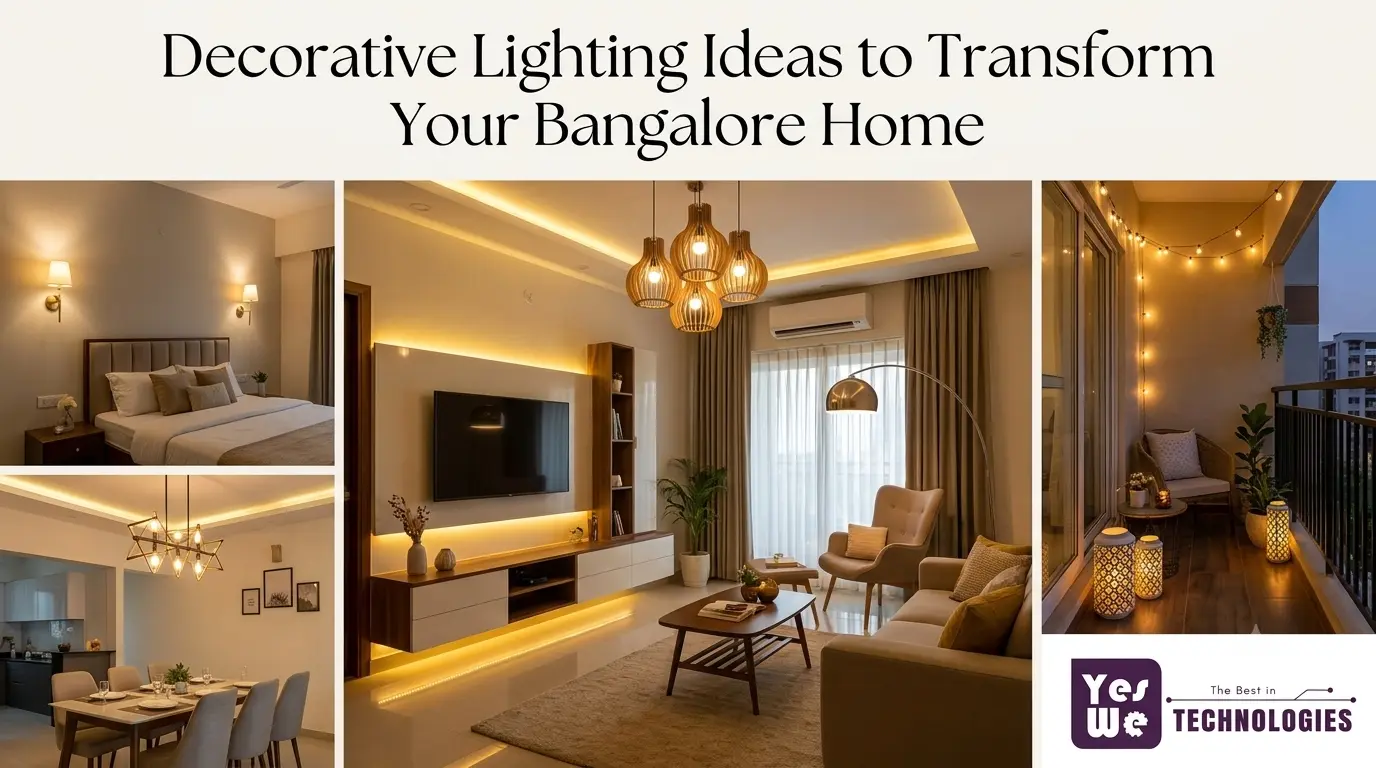
Most Bangalore homes have adequate lighting. You can see. The ceiling fixture works, the fan-with-light does its job, and the room is technically illuminated.
But adequate and beautiful are completely different things. The right decorative lighting design does not just illuminate a room – it changes how the room feels, how large it appears, and how differently it reads at 8 AM versus 8 PM. A living room that looks flat and unremarkable at noon can feel warm, layered, and genuinely inviting at 8 PM with the right lighting in place. Nothing else in interior design has that range of effect for the same investment.
This guide covers decorative lighting room by room, grounded in the specific realities of Bangalore homes: standard apartment ceiling heights, the open-plan layouts common in Prestige, Brigade, Sobha, and Godrej communities, and the growing integration between decorative lighting and smart home automation. Whether you are planning a full interior fit-out or upgrading an existing home, this is the guide that bridges aesthetic aspiration with practical installation decisions.
Key Takeaways
| 💡Layered lighting – ambient, task, and accent working together – is the foundation of any good decorative lighting design. Most Indian homes only have ambient. 💡Colour temperature shapes mood more than any other lighting variable. Warm 2700K for living rooms and bedrooms; neutral 3000K for kitchens and bathrooms; never cool white in living spaces. 💡Cove lighting in false ceilings is the single most impactful decorative upgrade for Bangalore apartments – but ceiling height determines the approach. At 9 feet, the shadow-line cove is usually smarter than a deep tray. 💡A pendant light directly above the dining table, hung at 75 to 90 cm above the surface, is the fastest single upgrade that visually transforms a dining area. 💡Magnetic track lights are the most flexible ceiling lighting format: the track goes up once, fixtures clip and rotate to any position, and the layout can change anytime without ceiling work. 💡Any decorative light worth installing should be dimmable. Fixed-brightness decorative lighting is a missed opportunity – brightness control is what makes a light truly versatile. 💡Smart dimmable and tunable lighting connects decorative fixtures to scenes: Movie Mode, Romantic 💡Dinner, Wake Up, Good Night – the same lights serve every occasion. 💡Yes We Technologies supplies and installs the full range of decorative lighting in Bangalore – from cove strips and spotlights to statement fixtures and smart dimmable systems. |
The Foundation: Layered Lighting and Colour Temperature
Before choosing any specific fixture, understanding two principles will improve every lighting decision you make. These are the frameworks interior designers and lighting specialists use – and they are not complicated.
The Three Layers of Lighting
Every well-designed room uses three types of lighting in combination. Most Bangalore homes have only the first.
| Layer | What it does | Examples |
|---|---|---|
| Ambient | General illumination – the base layer that lets you see the room | Ceiling light, cove lighting, recessed downlights |
| Task | Directed light for specific activities – reading, cooking, working | Under-cabinet strips, reading lamp, desk light, vanity mirror light |
| Accent | Decorative highlight – draws attention to specific elements | Spotlight on artwork, backlit headboard, TV bias lighting, shelf LED strip |
When only ambient lighting exists, a room looks flat regardless of how well the furniture and finishes are chosen. Adding task and accent layers creates depth, contrast, and the visual richness that makes a room feel designed rather than functional.
Colour Temperature: The Variable That Shapes Mood
Colour temperature is measured in Kelvin (K) and describes how warm or cool a light source appears. It is the single most impactful variable in decorative lighting – and the most frequently misunderstood.
| Colour Temperature | Appearance | Best Used In |
|---|---|---|
| 2700K | Warm amber – similar to candlelight | Bedrooms, living rooms (evening), dining areas |
| 3000K | Warm white – soft and clean | Kitchens, bathrooms, reading areas |
| 4000K | Neutral white – balanced, alert | Home office, study, kitchen task lighting |
| 5000K to 6500K | Cool daylight – crisp and energising | Utility areas, garages – not recommended for living spaces |
The practical rule: living rooms and bedrooms should be lit at 2700K for evening use. The cool white fluorescent tubes that are still common in Indian homes – typically 6500K – are visually harsh in residential spaces and work against any decorative intention you have. If you make only one change to your existing lighting, switching to 2700K LED sources is the highest-impact, lowest-cost upgrade available.
The Dimmability Rule
Any decorative light worth installing should be dimmable. A chandelier at fixed brightness is either too bright or too dim for half the occasions you use it. A pendant at 100 percent during a family dinner and at 30 percent during a quiet evening meal are two completely different experiences – and the difference costs nothing beyond a dimmable driver and a compatible switch.
Dimmability is not a luxury feature. It is what gives every decorative fixture its range and versatility. Plan for it from the start; retrofitting dimming capability after installation is significantly more complex and expensive.
Living Room: The Room That Earns the Most from Decorative Lighting
The living room is where decorative lighting delivers the highest visible return. It is the room seen by every guest, used by the whole family, and asked to perform across the widest range of activities: relaxed conversation, movie watching, bright family time, quiet evenings. The right layered approach means the same room transforms for each.
Cove Lighting in the False Ceiling
Cove lighting – LED strips hidden in a recessed ledge built into the false ceiling – is the single most popular and most transformative decorative lighting upgrade for Bangalore apartments. The light washes upward and outward, creating a soft glow that makes the ceiling appear higher and the room feel more spacious. At 2700K warm white, it creates exactly the warmth that living rooms need for evening use.
| Bangalore Ceiling Note: Most apartments in Whitefield, Koramangala, Sarjapur Road, and Hebbal have standard 9-foot (2740mm) slab-to-slab heights. A traditional tray false ceiling with 150 to 200mm drop is workable but leaves the finished room ceiling at roughly 8.5 feet – acceptable in larger rooms, noticeably compressed in smaller bedrooms. The shadow-line cove approach – a 50 to 70mm step rather than a full tray drop – achieves the cove light effect with minimal ceiling height sacrifice. If ceiling height is a concern, discuss the shadow-line option with your contractor. |
For cove lighting to work well, three things must be right: the cove recess must be at least 100mm deep for the light to spread without creating a harsh stripe, the LED strip must be dimmable (non-dimmable cove lighting is a very common and regrettable installation mistake), and the ceiling surface the light reflects off must be smooth and uniformly painted.
Recessed Spotlights and Downlights
Recessed downlights installed flush with the false ceiling provide directional ambient light without interrupting the visual plane. They are the workhorse of modern ceiling lighting – paired with cove lighting, they provide functional brightness while the cove provides atmosphere.
The placement rule: space downlights approximately 1.5 times the ceiling height apart. For a 9-foot ceiling, downlights spaced roughly 4.5 feet apart. For a 200 square foot living room, four to six well-positioned downlights are sufficient. The most common mistake is too many downlights – a ceiling covered in recessed lights looks like a car park, not a living room.
TV Accent and Bias Lighting
An LED strip placed behind the television screen – along the back edge of the TV panel – creates a soft halo of light that reduces eye strain during viewing, increases the screen’s perceived contrast (the brain interprets the screen as brighter against a controlled glow), and makes the whole setup look finished and considered.
Warm white 2700K to 3000K LED strip in an aluminium profile on the back of the TV, or on the wall immediately behind it, is one of the lowest-cost, highest-impact decorative additions to a living room. It costs a few thousand rupees and transforms how the screen area looks and feels during evening viewing.
The Statement Decorative Fixture
Every living room benefits from one fixture that is purely decorative – a chandelier, a cluster of pendant lights, a sculptural drum shade, or a statement ceiling rose. This is the fixture that becomes a conversation piece and anchors the room visually.
For Bangalore apartment living rooms with 9-foot finished ceilings, avoid large chandeliers that require more than 300mm of hanging length below the ceiling mounting point – they can feel uncomfortably low. Low-profile flush-mount chandeliers, cluster pendants that hang as a group from a single canopy, and large architectural ceiling roses with slim pendants all work well within the ceiling constraints.
Master Bedroom: Lighting That Works Across the Full Range
The bedroom’s lighting goal is different from every other room: it needs to be dim enough to sleep in and bright enough to dress in, with everything in between for reading, relaxing, and waking up. A single overhead light cannot do all of this. A layered system can.
Cove Lighting in the Bedroom
A bedroom cove at 2700K warm white, always dimmable, is the ambient base layer. The critical installation detail: the cove should be positioned so the light washes away from the bed rather than toward it. Direct cove light aimed at a reclining person’s eyes is uncomfortable; light washing outward along the ceiling creates the soft halo effect without any glare.
Bedside Pendant Lights
Bedside pendant lights hung from the ceiling on adjustable cables are one of the most practical bedroom upgrades available. They free the bedside table of lamp clutter, can be positioned exactly where needed, are individually adjustable for each partner, and look considerably more considered than a pair of matching table lamps. At 2700K and dimmable, they are also the ideal reading light.
The hanging height: the bottom of the pendant shade should be at approximately seated shoulder height – around 55 to 65 cm above the mattress surface when sitting up in bed.
Accent Lighting Ideas Worth Doing
- Backlit headboard panel: An LED strip in a warm 2700K placed behind the headboard – either recessed into a panel or running in an aluminium profile along the top of the headboard – creates a soft halo that defines the bed as the room’s focal point. One of the most photographed bedroom lighting details.
- Wardrobe interior lighting: Motion-activated LED strips inside the wardrobe illuminate the contents when doors open and switch off automatically when closed. Practical and visually impressive.
- Under-bed LED strip: A warm amber LED strip running along the base of the bed platform, glowing downward toward the floor, functions as a night light for low-level navigation without disturbing sleep – and looks like a hotel room detail.
Tunable White for Bedrooms
The bedroom is the room where tunable white lighting – LED sources that shift colour temperature across a range, typically 2700K to 5000K – delivers the most measurable daily value. Cool white in the morning supports natural waking; warm amber in the evening promotes melatonin production and better sleep. When connected to a smart home system on a circadian schedule, the lights make this shift automatically throughout the day without any manual adjustment.
Dining Area and Kitchen: Function-First with Decorative Intention
Dining Area: The Pendant Light Rule
A pendant light or a cluster of pendants hung directly above the dining table is the single most impactful visual upgrade to a dining area – and one of the simplest to execute. Done well, it defines the dining zone within an open-plan space, draws the eye downward to the table, and creates an atmosphere that transforms how a meal feels.
The mechanics: the bottom of the pendant shade should hang 75 to 90 cm above the table surface – low enough to illuminate the table without shining into seated diners’ eyes, high enough to not obstruct sightlines across the table. Pendant diameter should be roughly half the table width. A 150 cm dining table suits a single 70 to 80 cm pendant or a cluster of three smaller pendants.
Colour temperature for dining: 2700K warm white, always dimmable. The difference between a dining pendant at 100 percent and at 40 percent during dinner is the difference between eating in a canteen and eating in a restaurant. This single dimmer switch changes everything.
Kitchen: Solve the Counter Shadow Problem First
The most common lighting problem in Indian kitchens is that the overhead ceiling light is blocked by the cook’s own body, casting a shadow directly over the work surface. You are cutting vegetables in your own shadow.
The solution is under-cabinet LED strip lighting: strips mounted on the underside of the upper wall cabinets illuminate the counter directly from above and in front of the cook, with no shadow. Warm 3000K is the right temperature for kitchen work – bright enough for precision without the harshness of cool white.
| Bangalore Kitchen Ceiling Note: Most Indian apartment kitchens have ceilings under 9 feet after finishing. Avoid false ceiling drops here – they compress an already compact space and rarely add value. A flat gypsum ceiling with one or two recessed downlights for general illumination, combined with under-cabinet LED strips for task lighting, is the right approach. All the useful light comes from the counter level, not from above. |
Spotlights, Magnetic Track Lights, and LED Strips: The Flexible Accent Layer
These are the products that give decorative lighting plans their versatility – the tools that highlight, define, and accent without structural commitment.
Spotlights
Fixed recessed spotlights direct a beam of light at a specific target: an artwork, an accent wall, a plant, a display shelf. Unlike general downlights, spotlights are narrow-beam and directional – they do not illuminate the room broadly; they illuminate a specific object. Used well, they create drama and depth. Used poorly – aimed at blank walls without a clear target – they are just odd-looking ceiling holes.
The right use cases for spotlights: highlighting artwork or a framed family photograph, accenting a feature wall with texture or colour, illuminating a display cabinet, or creating a dramatic pool of light on a reading chair or accent table.
Magnetic Track Lights
Magnetic track lighting is growing rapidly in popularity across premium Bangalore apartments – and for good reason. A magnetic track consists of a recessed or surface-mounted aluminium rail with an embedded low-voltage conductor. Individual light fixtures clip onto the track magnetically and can be positioned anywhere along the rail, rotated to any angle, and removed and repositioned at any time – without any ceiling work. Spotlights and magnetic track lights offer the highest flexibility of any ceiling lighting format.
The track goes up once. Everything else is adjustable forever after. If you rearrange furniture, reposition the fixtures. If you add a new artwork, angle a spotlight toward it. If you want to change the distribution of light in a room, slide the fixtures along the track. No electrician required for any of these changes.
Where magnetic track lighting works best: open-plan living and dining areas where furniture and artwork positioning may evolve over time, home offices with changing workstation layouts, dining areas where a long pendant cluster would feel too fixed, and any room where flexibility is a priority over permanence.
LED Strip Lighting: The Versatile Background Layer
LED strip lighting is the most versatile decorative lighting tool available – and also the most frequently done poorly. Quality and installation method matter significantly. Decorative lighting that includes LED strip applications should always specify aluminium profile housing for the strips – profiles improve heat dissipation (extending strip lifespan significantly), provide a clean diffused light rather than visible individual LED dots, and give a professional finish.
LED strip applications by location:
- Cove lighting in false ceilings: the primary use; hidden in a recessed ledge, washing light upward
- Under kitchen cabinets: task lighting on the counter surface, warm 3000K
- Behind the television: bias lighting for eye comfort and perceived contrast, warm 2700K
- Under shelving and display units: accent lighting on displayed objects, books, collectibles
- Behind a headboard panel: bedroom accent, warm 2700K, always dimmable
- Under the bed platform: night navigation, warm amber, motion-sensor triggered
- Staircase edges and corridor floors: safety and atmosphere in equal measure
- Balcony perimeter and planters: outdoor accent, requires weatherproof IP65-rated strips
The quality point: cheap LED strips sold in bulk online are inconsistent in colour, fade quickly, and often flicker. For any prominent decorative application – cove lighting, headboard backlight, behind the TV – invest in quality strips with good CRI (colour rendering index above 80, ideally 90+) and pair them with aluminium profiles for a finish that looks considered rather than DIY.
Smart Decorative Lighting: Where Aesthetics and Automation Meet
A decorative lighting design that responds to scenes, schedules, and voice commands is a fundamentally different experience from one controlled by fixed switches. This is where the aesthetic investment you make in decorative fixtures is multiplied by the automation layer that controls them.
The Core Principle: Every Decorative Light Should Be Dimmable
Fixed-brightness decorative lighting is a missed opportunity. A chandelier at full brightness is too bright for a quiet evening and too dim for a family gathering. A dining pendant at fixed intensity cannot shift from homework session to dinner party ambience. The dimmer – whether a manual control or a smart switch – is what gives every decorative fixture its range.
Smart dimmable and tunable lighting connects your decorative fixtures to app control, voice commands, and automation scenes – so the lighting adjusts not just to your preference but to the time of day and the activity in progress, automatically.
Tunable White in Practice
A tunable white system allows a light source to shift its colour temperature across a range – typically 2700K warm to 5000K cool – via a smart controller. In a living room, this means the ceiling cove and pendant automatically shift from neutral 4000K during the afternoon to warm 2700K amber by 7 PM, without any manual input. In a bedroom, it supports a circadian rhythm: cool white in the morning supports waking, warm amber in the evening promotes sleep readiness.
The technology is mature and cost-effective. The colour shift is visible and meaningful. And when connected to a home automation platform, it runs on a schedule you set once and never think about again.
Decorative Lighting in Smart Home Scenes
When decorative lighting is integrated with a smart home system, the same fixtures participate in scenes that transform the room:
- Movie Mode: Living room cove dims to 5 percent warm amber, recessed downlights off, TV bias lighting activates, chandelier off. The room transitions to cinema mode in one tap.
- Romantic Dinner: Dining pendant dims to 40 percent warm 2700K, all other lights off. A completely different atmosphere from the same fixture used at 100 percent for a family lunch.
- Wake Up: Bedroom cove and bedside pendant ramp gradually from 0 to 30 percent neutral 3000K over 20 minutes, starting before the alarm. The room brightens naturally rather than with a jarring switch.
- Party Mode: Living room all layers at 80 percent warm white, chandelier at 100 percent, dining pendant at 60 percent. Maximum social warmth.
- Good Night: All decorative lights off except bedroom cove at 5 percent for navigation. One command turns off every light in the home.
Integrating decorative lighting with a home automation system connected to smart touch switches and voice assistants – means these scenes are activated by a tap, a voice command, or automatically on a schedule. The same lights that illuminate your Sunday family lunch transform your Monday evening into a cinema and your Friday dinner into something special.
Decorative Lighting Design and Installation in Bangalore: Yes We Technologies
Good decorative lighting is not just about choosing the right fixture. It is about understanding how layers work together, specifying the right colour temperature for each application, ensuring every source is dimmable from the start, and integrating the decorative design with smart automation so the lighting is as functional as it is beautiful.
Yes We Technologies supplies and installs the complete range of decorative and functional lighting solutions across Bangalore – for apartments, independent homes, and villas in Whitefield, Indiranagar, Koramangala, Sarjapur Road, Hebbal, Electronic City, Jayanagar, Banashankari, JP Nagar, HSR Layout, and all areas across the city.
What Yes We Technologies delivers for decorative lighting in Bangalore:
- Decorative fixtures: statement chandeliers, cluster pendants, dining pendants, bedside pendants, wall sconces – specified for Indian ceiling heights and electrical specifications
Cove lighting installation: LED strip selection, aluminium profile housing, dimmable driver specification, and integration with dimmable and tunable lighting systems.
Spotlights and magnetic track lighting: track selection, fixture layout design, installation and alignment – explore spotlights and magnetic track lights in Bangalore.
- LED strip lighting in aluminium profiles: cove, under-cabinet, TV bias, headboard, under-bed, staircase, balcony – correctly specified for each application
- Dimmable and tunable white systems: circadian lighting, scene-compatible drivers, and smart controller configuration
- Smart home scene setup: Movie Mode, Romantic Dinner, Wake Up, Good Night, Party Mode – programmed and tested before handover
- Complete integration with home automation: lighting scenes connected to curtain automation, HVAC, AV, and security through a single gateway
| Book a Free Lighting Consultation Phone: +91 9620555565 Email: enquiry@yeswe.in Address: #29, Opp. BESCOM, DLF Main Road, Bannerghatta Road, Hulimavu, Bengaluru – 560076 |
Frequently Asked Questions
1. What is the best colour temperature for living room lighting in a Bangalore home?
2700K warm white for evening and social use – the warm amber tone creates the comfortable, inviting atmosphere that living rooms need. For a home where the living room also doubles as a study or work area during the day, tunable white lighting that shifts between 4000K neutral during working hours and 2700K warm in the evenings gives you the full range without any manual switching.
2. Is cove lighting possible in a Bangalore apartment with standard 9-foot ceilings?
Yes, but the approach matters. A traditional tray false ceiling with a full 150 to 200mm drop leaves the finished ceiling at roughly 8.5 feet – workable in larger rooms but noticeably compressed in smaller ones. The shadow-line cove – a 50 to 70mm step rather than a full tray – achieves the indirect glow of cove lighting with minimal ceiling height sacrifice. For rooms where every centimetre of height matters, a surface-mounted crown moulding cove (moulding at the ceiling-wall junction with a recessed LED strip behind it) is the most space-efficient option.
3. How high should a pendant light hang above a dining table?
75 to 90 centimetres above the table surface is the standard range. At this height the pendant illuminates the table directly without shining into seated diners’ eyes or obstructing sightlines across the table. For multiple pendants over a long dining table, maintain the same drop height across all fixtures. A pendant hung significantly higher than 90 cm starts to lose its visual connection with the table and its effectiveness as a focused light source.
4. What is magnetic track lighting and why is it popular in Bangalore homes?
A magnetic track light system consists of a recessed or surface-mounted aluminium rail with an embedded low-voltage electrical conductor. Individual spotlights and pendant fixtures clip onto the track magnetically and can be repositioned along the rail or rotated to any angle without any electrical work. In Bangalore apartments where furniture and artwork arrangements may evolve over time, this flexibility makes magnetic track lighting significantly more practical than fixed recessed spotlights. Once the track is installed, the lighting layout can be changed at any time.
5. Should LED strips be installed with aluminium profiles?
Yes, for any prominent decorative application. Aluminium profiles serve three functions: they improve heat dissipation from the LED strip, significantly extending its lifespan; they diffuse the light through a frosted cover, eliminating visible individual LED dots for a smooth, even glow; and they give the installation a clean, professional finish. Raw LED strips adhered directly to surfaces without profiles look DIY in a way that undermines the decorative intention. For cove lighting, TV bias lighting, and headboard backlighting, aluminium profiles are the correct specification.
6. What is the difference between dimmable and tunable white lighting?
Dimmable lighting adjusts brightness – from full output down to a fraction of it. Tunable white lighting adjusts colour temperature – from warm amber at 2700K to cool daylight at 5000K or above. The two can be combined: a tunable white dimmable fixture adjusts both brightness and warmth simultaneously. For living rooms and bedrooms, a tunable white system connected to a smart home automation schedule provides the full range: bright and neutral in the morning, warm and dim in the evening, automatically.
7. How does decorative lighting integrate with a smart home system?
Dimmable and tunable decorative fixtures connect to a smart home system through smart dimmable drivers, smart switches, or dedicated smart bulb bases. Once connected, they participate in automation scenes: Movie Mode dims the cove and turns off the chandelier; Romantic Dinner dims the dining pendant to 40 percent warm white; Good Night turns everything off except a low-level navigational glow. Yes We Technologies installs decorative lighting as part of complete home automation systems in Bangalore, programming scenes and schedules before handover.
8. What is the most cost-effective decorative lighting upgrade for an existing Bangalore home?
Two upgrades deliver the highest impact for the lowest investment in an existing home: replacing existing bulbs with high-CRI 2700K LED sources (immediately changes the warmth and quality of every light in the home), and adding an LED strip behind the television with a dimmable driver (transforms the TV area and improves viewing comfort). Both can be done without any ceiling or electrical work. For a slightly larger investment, a dimmable pendant above the dining table is the single fixture change with the most visible design impact.