

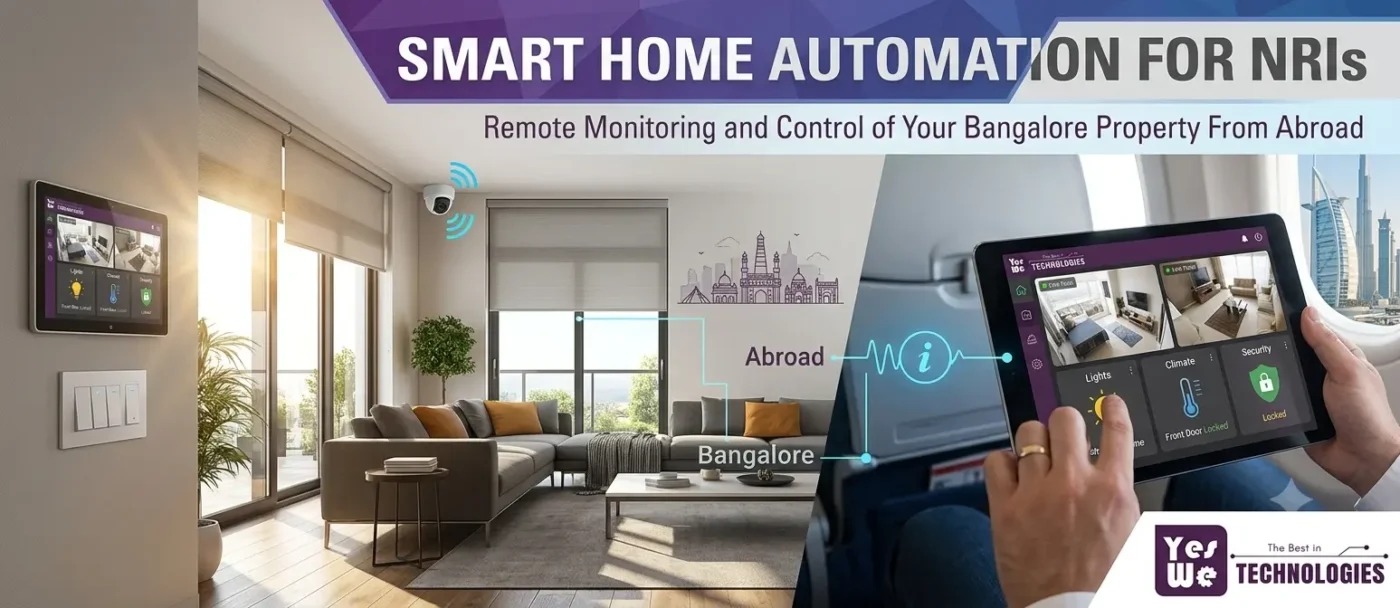
You are in Singapore. It is 11 PM local time. Your phone buzzes — a motion alert from the CCTV inside your Bangalore apartment. You open the app, see the live camera feed, and realise it is the domestic help you forgot was coming today. You watch her work for a few minutes, confirm everything looks normal, and go back to what you were doing.
This is what smart home automation means for an NRI. Not luxury. Reassurance.
For Non-Resident Indians with property in Bangalore — whether it is a flat in Whitefield that was once the family home, a Sarjapur Road apartment held as an investment, or a villa in Hebbal waiting for your eventual return — the anxiety of managing property from thousands of kilometres away is real and specific. Pipes burst. Domestic help come and go. An electrical short happens when no one is there to catch it. A property manager says everything is fine, but you have no way to independently verify.
Smart home automation does not replace a property manager or a trusted family member nearby. But it gives you an independent layer of visibility and control that you did not have before — from anywhere in the world, at any hour, without waiting for someone to pick up the phone.
This guide covers what specifically NRIs should set up, in what order, and what makes the setup actually work reliably when the property is thousands of kilometres from where you are.
Key Takeaways
| 💡 Smart home automation for NRI-owned Bangalore properties is not about convenience — it is about independent visibility and risk management from abroad. 💡CCTV with cloud storage and motion alerts gives you a live feed and recorded history of everything that happens at the property, viewable from any device worldwide. 💡Smart door locks with OTP-based temporary codes let you manage domestic help and maintenance access remotely — no physical key handover, no trust required. 💡Water leak sensors are the single highest-ROI safety device for a vacant Indian flat — a burst pipe found late causes floor damage, ceiling damage to the flat below, and neighbour disputes you cannot manage from abroad. 💡Occupancy simulation — lights and curtains on a randomised schedule — makes a vacant flat look lived-in, reducing its attractiveness as a target. 💡The entire remote monitoring system depends on two things the property must have: a reliable broadband connection with 4G backup, and a UPS keeping smart devices powered during power cuts. 💡An Annual Maintenance Contract with a local Bangalore home automation partner is not optional for NRIs — it is the difference between a system that works for five years and one that fails in month two with no one to fix it. 💡Yes We Technologies provides installation, configuration, and AMC services specifically designed for NRI-owned properties across Bangalore. |
What Can Actually Go Wrong in a Vacant Bangalore Property
Most smart home guides start with features. This one starts with risks — because that is what NRI property owners are actually thinking about, and the risk profile of a vacant Bangalore flat is specific enough to shape every device decision that follows.
Security Breach and Unauthorised Entry
A property that is visibly unoccupied for extended periods attracts attention. Building staff, maintenance contractors, and even other residents sometimes notice patterns of absence. In India, where informal social networks in residential communities are dense, word that a flat has been empty for six months travels quickly. Unauthorised entry — ranging from opportunistic pilfering to more serious occupation — is a real risk for long-vacant properties, particularly for ground-floor or less-visible units.
A flat that is monitored, that shows visible signs of occupancy, and that records every entry and exit is significantly less attractive to anyone considering it.
Water Damage — The Highest Financial Risk
This is the risk NRI property owners underestimate most severely. A burst pipe, an overflowing overhead tank, a failed washing machine inlet valve, or a blocked drain in an unoccupied flat can run water for hours or days before anyone notices. The damage is not just to your property — water seeps through the floor slab into the flat below, triggering disputes and compensation claims from neighbours that are extremely difficult to manage while abroad.
In Bangalore’s older apartment buildings, corroded pipe connections and ageing overhead tank fittings make water incidents more common than owners assume. For a vacant flat, this is the category of risk that justifies automation investment on its own.
Fire, Electrical Fault, and Gas Hazard
An electrical short from a failing appliance left plugged in, a rodent that has chewed through insulation in a vacant flat, or an LPG cylinder connection that was not properly shut off before the owners left — these are low-probability events with catastrophic consequences when no one is home to detect and respond. A smoke alarm that goes off in an occupied flat gets immediate attention. In a vacant flat, it alerts neighbours at best and goes unnoticed at worst.
Unauthorised Occupation
In India, long-term vacant properties carry legal vulnerability. The law around adverse possession and the practical reality of tenant dispute resolution means that a property occupied without authorisation becomes a significantly more complex problem to resolve the longer it continues. A monitored, apparently occupied flat with documented access control is a much stronger position legally and practically.
Maintenance Failures That Compound Over Time
An air conditioning drain that overflows slowly and damages the false ceiling. A geyser that develops a slow leak. A refrigerator left running that fails. A seepage through the external wall after monsoon. These issues are routine in Indian homes — the difference is that in an occupied home they are caught and fixed quickly. In a vacant flat, a minor issue can escalate to major damage before anyone notices.
The Remote Monitoring Layer: What to Install First
These are the devices that give you eyes and ears at the property — the foundation of remote monitoring before anything else.
CCTV Cameras
Two to three wireless IP cameras positioned strategically give you comprehensive visibility of the property. The placement that matters most for a vacant flat:
- Main living area, angled to cover the main entrance: catches anyone entering and shows the general state of the property
- Main door interior: direct view of who enters and exits through the primary access point
- Any secondary access point — a balcony door, a utility entrance, or a back corridor if present
For NRI monitoring, what matters most in camera selection:
- Cloud storage with 7 to 30 day rolling history: not just live view, but a recorded timeline you can review at any time from abroad — essential for verifying what happened, when, and who was responsible
- Motion detection with push notifications: instant alert to your phone when movement is detected, with a short video clip showing what triggered it — so you do not need to actively monitor but are alerted immediately when something happens
- Night vision: standard requirement — most incidents at vacant properties happen after dark
- Two-way audio: the ability to speak through the camera is surprisingly useful — you can instruct domestic help, answer a maintenance query, or make your presence known if something looks wrong
A professional CCTV installation in Bangalore with correct placement, mounting height, and angle ensures there are no blind spots in your coverage — something that generic self-installed cameras frequently fail at.
Smart Door Lock
The smart lock is the access management device that changes everything about how you handle who enters your property from abroad.
- OTP and time-limited access codes: generate a one-time or time-limited access code from your phone in London, send it via WhatsApp to the domestic help or a maintenance technician, and the code works only during the permitted window — Monday to Friday, 9 AM to 11 AM, for example. It never generates a physical key that could be copied.
- Access log: every entry and exit is timestamped and viewable from your phone abroad. You can verify that the domestic help entered at 9:15 AM and left at 10:45 AM as expected, without asking anyone.
- Auto-lock: the door locks automatically after 30 seconds — no risk of the flat being left unlocked after a visit
- Instant alert on unexpected entry: notification to your phone if the door opens at an unusual time or outside the permitted window for any active code
Well-integrated smart door locks in Bangalore with a mechanical key backup as failsafe ensure the flat is never inaccessible to authorised people even if the smart system has a temporary issue.
Video Door Phone
A VDP at the main door lets you see and speak to anyone who rings the bell from wherever you are in the world — a delivery person, a neighbour, a maintenance contractor, or an unexpected visitor.
When combined with a smart door lock, you can verify a visitor through the video door phone in Bangalore and remotely unlock the door for them from your office in Dubai — your property operates as if you were physically home.
The Environmental Safety Layer: Sensors NRIs Cannot Afford to Skip
This section addresses the risk category that causes the most financial damage to NRI-owned vacant properties in India — and the one that generic smart home guides almost never cover adequately.
Water Leak Sensors
For a vacant Indian flat, water leak sensors are arguably more valuable than CCTV cameras. Here is why: a security breach is visible, disruptive, and rare. A water leak is invisible, happens silently, and given Indian plumbing infrastructure, is far more common than NRI property owners expect.
Place water leak sensors at:
- Under the kitchen sink — where pipe connections corrode and joints loosen
- At the washing machine inlet and outlet connections
- In the bathroom near the floor drain and at pipe entry points
- At the overhead tank connection if accessible
When water is detected, you receive an immediate push notification to your phone. For properties at higher risk or with high-value flooring and finishes, a motorised solenoid water shut-off valve connected to the sensor automatically closes the main water supply within seconds of leak detection — the leak stops without anyone needing to be physically present. This single device prevents the most common and most expensive type of damage to NRI-owned vacant flats in Bangalore.
Smoke and Fire Sensors
Standard smoke detectors should be in every room with electrical appliances and in the kitchen — standard practice for any home. For vacant properties, the critical addition is that the smoke sensor should be connected to the smart home system so that it pushes a notification to your phone abroad, not just triggers a local siren. A siren in an empty flat may alert a neighbour eventually; a push notification to your phone while you are in the UK alerts you immediately and allows you to call building management or emergency services within minutes.
LPG Gas Leak Sensor
If the property has a gas connection — as most Indian kitchens do — a gas leak sensor monitoring LPG concentration is essential for a vacant flat. The risk profile of an unoccupied flat with a gas connection is different from an occupied one: there is no one to smell a slow leak early, and the buildup can reach hazardous concentration before anyone notices. An LPG sensor with smart home integration provides an immediate alert and, in advanced setups, triggers a motorised gas solenoid valve to shut off automatically.
Temperature and Humidity Sensors
Less urgent than water and gas, but useful for two reasons: an unusually high temperature reading may indicate an appliance failure or electrical fault, and high humidity over time indicates a seepage issue developing before it becomes visible damage. These sensors provide ambient property monitoring that catches developing problems early.
| For NRI owners of Bangalore properties: the insurance implication of environmental sensors is significant. Several Indian home insurance policies have provisions that reduce or void claims for damage that could have been detected and mitigated with reasonable monitoring. A documented smart sensor system strengthens your position significantly in any damage claim. |
Access Management: Running Your Bangalore Home from Abroad
A smart home system gives you something a property manager alone cannot: independent verification. You do not have to rely on someone else’s word about whether the domestic help came, whether the maintenance was done, or whether the flat is in the condition you expect. You can verify it yourself from wherever you are.
Domestic Help Management
For most NRI-owned Bangalore properties, domestic help continues working while the owners are abroad — cleaning the flat, watering plants, or maintaining a general presence. Managing this remotely without a smart system means trusting that the help is actually coming as agreed, working as expected, and not bringing unauthorised people into the property.
With a smart door lock and CCTV:
- Issue time-limited access codes specific to the permitted days and hours — the help can only enter when authorised, and cannot pass on the code to anyone else because it expires
- Receive a notification when entry and exit happen — verify the schedule is being followed without asking anyone
- Review CCTV footage for any visit — optional, but available if there is ever a question
- Revoke access instantly from your phone if the arrangement changes — no key recovery required
Maintenance and Repair Access
The AC needs a service. The building’s plumber is coming. The electrician needs to check the meter. Managing these access events from abroad without smart systems is a logistical challenge — you need a trusted person to be physically present, coordinate schedules across time zones, and hand over and recover a physical key.
With a smart lock and CCTV, you generate a one-time access code for the technician, share it via WhatsApp, review the CCTV footage to confirm the work was done and the flat was left in order, and the access code expires without any follow-up required. The entire interaction is managed from abroad in under five minutes.
Trusted Local Contact
Smart home app access can be shared with a trusted family member, a close friend, or a building-resident you trust. They receive the same motion alerts and sensor notifications, can check the live CCTV feed if something looks unusual, and can respond locally to a situation you have identified remotely. You maintain master control; they have operational visibility and local response capability. This is the most effective model for NRI property monitoring: technology for independent verification, and a trusted local person for physical response when needed.
Occupancy Simulation: Making a Vacant Flat Look Lived-In
A vacant flat is identifiable. Curtains that never move, lights that never turn on, no sounds, no activity at the door — over weeks and months, the pattern becomes obvious to anyone who is paying attention. Occupancy simulation is not about fooling anyone for long; it is about removing the visible signals that make a property look like an easy target.
Smart Lighting Schedules
Programme the living room light to turn on at 7:30 PM and off at 10:30 PM. The bedroom light on at 9:00 PM and off at 11:15 PM. The kitchen light briefly at 7:00 AM. These patterns, visible through windows and from the corridor, suggest a home that is being used — not a vacant property.
Randomising the timing slightly each day — 7:30 PM on Monday, 7:48 PM on Tuesday — makes the pattern look organic rather than mechanical, which is more convincing to anyone observing over time. Some smart home platforms support this natively; others can be configured manually with staggered schedules.
Motorised Curtain Schedules
Motorised curtains that open at 8 AM and close at 7 PM on a daily schedule create the visual rhythm of an occupied home. Combined with the lighting schedule, the flat appears to be in use. Curtain automation in Bangalore is one of the most visible and effective occupancy simulation tools for ground-floor and low-rise apartment units where curtain movement is visible from outside.
Smart AC Scheduling for Asset Protection
Running the AC briefly — perhaps 30 minutes twice a week — is not about cooling an empty flat. It is about preventing the compressor from seizing due to extended non-use, which is a common and expensive failure mode for AC units left completely idle for months. This small operational cost protects a significant appliance investment and avoids a maintenance call that might otherwise require your in-person attention or significant coordination from abroad.
What Makes the System Actually Work from Abroad: Infrastructure Essentials
A smart home monitoring system for a vacant property is only as reliable as the infrastructure it depends on. These are the operational foundations NRIs must get right — devices alone are not enough.
Internet Reliability at the Bangalore Property
Every remote monitoring feature — live CCTV feed, motion alerts, lock notifications, sensor alerts, remote door unlock — depends on the property’s broadband connection. If the ISP goes down, cameras lose cloud connectivity, alerts stop arriving, and your remote visibility disappears entirely.
The solution for NRI properties: a 4G LTE backup router that activates automatically when the primary fibre connection fails. The router detects the outage and switches to a mobile data SIM within seconds, keeping the smart home system connected through the ISP interruption. For most NRIs, this single addition makes the difference between a system that is reliably visible from abroad and one that goes dark at the worst moments.
Power Backup for Smart Devices
Power cuts remain a reality in Bangalore, particularly in older residential zones during monsoon season. When power fails, every smart device in the flat goes offline unless it has battery or UPS backup. A UPS connected to the home automation gateway, the Wi-Fi router, and the CCTV cameras keeps the monitoring system running through short outages. For the smart door lock, most battery-operated models continue functioning through power cuts independently.
Annual Maintenance Contract — Not Optional for NRI Properties
This is the most important practical point in this entire guide for NRI property owners. A smart home system installed today will need attention over the next five years: a camera that needs repositioning, a sensor that needs a battery, a lock firmware update, a gateway that needs reconfiguration after an ISP change, a water sensor that needs its detection plate cleaned.
For an NRI who cannot travel back to Bangalore every time a device needs attention, an Annual Maintenance Contract with the installing company is not a nice-to-have. It is the mechanism that keeps the system functional. Without it, a device that fails in month six goes unfixed, and your monitoring system has a blind spot you may not notice until something goes wrong.
Yes We Technologies provides AMC support as part of every home automation installation in Bangalore — the same team that installs the system maintains it, providing NRI property owners with a single point of contact for all maintenance needs without the coordination overhead of managing multiple vendors from abroad.
India-Compatible Device Selection
All smart devices should be rated for Indian electrical specifications — 220V/50Hz — and tested for Bangalore’s humidity and temperature ranges. Devices sourced through global e-commerce platforms at attractive prices are sometimes designed for US (110V/60Hz) or European specifications and degrade or fail prematurely in Indian conditions. Professional installation through a local partner ensures every device is correctly specified for Indian operating conditions.
What a Complete NRI Smart Home Setup Looks Like in Practice
To make this concrete, here is what a well-configured smart home system for a vacant NRI-owned 3BHK apartment in Bangalore covers:
| Category | Device | What it gives you from abroad |
|---|---|---|
| Remote monitoring | 3 wireless IP cameras (living room, main door, secondary access) | Live feed, motion alerts with video clip, 30-day cloud recording |
| Access control | Smart door lock with OTP codes | Managed access for domestic help and visitors, access log, remote unlock |
| Visitor verification | Video door phone | See and speak to anyone at the door, unlock remotely |
| Water safety | Leak sensors under sink, at washing machine, bathroom | Instant alert when water detected, option to auto-shut water supply |
| Fire safety | Smoke sensors in kitchen, living room, bedrooms | Push notification to phone abroad, local siren for neighbours |
| Gas safety | LPG sensor in kitchen | Immediate alert, optional auto gas shut-off valve |
| Occupancy simulation | Smart lighting + motorised curtains on schedule | Visible occupancy rhythm, deterrence, asset protection |
| System reliability | UPS for gateway, router, and cameras; 4G LTE backup router | Monitoring continues through power cuts and ISP interruptions |
| Long-term reliability | Annual Maintenance Contract | System stays functional for years without your physical presence |
Managing Your Bangalore Property from Abroad: Yes We Technologies
The difference between a smart home system that gives you genuine peace of mind and one that becomes a source of frustration is not the devices — it is the quality of installation, the reliability of the infrastructure, and the availability of professional local support when things need attention.
Yes We Technologies works specifically with NRI property owners across Bangalore — designing, installing, and maintaining smart home monitoring systems for apartments, independent homes, and villas that are occupied part-time or entirely vacant. We understand the specific risk profile of a vacant Bangalore property and the specific operational requirements of a system that must be managed from Singapore, London, Dubai, the US, or anywhere else in the world.
What Yes We Technologies delivers for NRI property owners in Bangalore:
- Free consultation and property assessment: we visit the property, identify risks, assess existing infrastructure, and design a system matched to the actual vulnerabilities and access patterns of your specific flat
- CCTV installation with cloud storage and motion alerts configured for remote monitoring — cameras placed for blind-spot-free coverage, connected to a platform you can access from any device worldwide
- Smart door lock installation with OTP code configuration for domestic help and visitors — full access management setup before handover
- VDP installation and integration with the smart lock for complete entry verification and remote access control
- Environmental sensor installation: water leak sensors, smoke sensors, gas sensors — all connected to the smart home system and configured to send push notifications to your phone abroad
- Occupancy simulation configuration: lighting schedules, curtain automation, and AC scheduling set up for the property’s specific layout and visibility
- 4G LTE backup router configuration and UPS setup for monitoring continuity through ISP and power interruptions
- Annual Maintenance Contract: scheduled visits, remote troubleshooting, firmware updates, sensor maintenance, and on-call response for device issues — all coordinated with you by phone, WhatsApp, or email from wherever you are
Serving NRI-owned properties across Whitefield, Indiranagar, Koramangala, Sarjapur Road, Hebbal, Electronic City, Jayanagar, Banashankari, JP Nagar, HSR Layout, Bellandur, Marathahalli, Devanahalli, and all areas across Bangalore.
| Book a Free Property Assessment — Yes We Technologies Phone: +91 9620555565 Email: enquiry@yeswe.in WhatsApp: +91 9620555565 Address: #29, Opp. BESCOM, DLF Main Road, Bannerghatta Road, Hulimavu, Bengaluru – 560076 |
Frequently Asked Questions
1. Can I really monitor my Bangalore property from abroad using smart home automation?
Yes — and for most NRI property owners, remote monitoring is the primary reason to install smart home automation. With a professional CCTV system connected to cloud storage, a smart door lock with OTP access codes, and environmental sensors, you have real-time visibility of your property, verified access management for domestic help, and immediate alerts for security or safety events — all from any device, from anywhere in the world, at any time.
2. What happens to my smart home monitoring system during a power cut in Bangalore?
Without backup power, smart devices go offline when power fails. With a UPS connected to the Wi-Fi router, home automation gateway, and CCTV cameras, these devices continue running through power cuts — maintaining your remote monitoring and access control. Smart door locks on battery power continue operating independently. For longer outages, CCTV cameras with local SD card backup continue recording locally even if cloud connectivity is temporarily unavailable.
3. What happens if my Bangalore property’s internet connection goes down?
If the primary broadband connection fails, all cloud-dependent remote monitoring stops until connectivity is restored. The solution for NRI properties is a 4G LTE backup router that automatically switches to mobile data when the fibre connection drops — keeping the CCTV feed, motion alerts, and remote access control available through the ISP interruption. Yes We Technologies configures this backup connectivity as part of the NRI-specific setup.
4. How do I manage domestic help access to my Bangalore flat when I am abroad?
A smart door lock lets you issue time-limited OTP access codes from your phone abroad — a code that works only on specified days and times, then expires automatically. The access log shows you exactly when entry and exit happened. CCTV footage from the visit is available for review. If the arrangement changes, you revoke access instantly from your phone. No physical key is ever involved, so there is no risk of key copying or loss.
5. What is the most important safety device for an NRI-owned vacant Bangalore flat?
Water leak sensors, particularly for apartments. A burst pipe or failed washing machine connection in a vacant flat can run undetected for hours or days, causing significant damage to your property and the flat below — triggering disputes and insurance claims that are extremely difficult to manage from abroad. A water leak sensor with push notification to your phone abroad — and optionally a motorised water shut-off valve — is the single highest-ROI safety investment for a vacant Bangalore property.
6. Can I make my vacant Bangalore flat look occupied from abroad?
Yes — this is called occupancy simulation and it is a standard feature of a well-configured smart home system. Smart lighting programmed to turn on and off at natural times (living room light 7:30 to 10:30 PM, bedroom light 9 to 11 PM), motorised curtains on a daily open-and-close schedule, and a slight randomisation of timing each day creates the visible rhythm of an occupied home. This reduces the property’s attractiveness as a target for anyone monitoring for vacant flats.
7. Do I need an Annual Maintenance Contract for my NRI smart home system in Bangalore?
For NRI-owned properties, an AMC is not optional — it is the mechanism that keeps the system functional for years without your physical presence. A camera that needs repositioning, a sensor that needs a battery, a firmware update that changes an app login, a gateway that needs reconfiguration after a router change — these are routine maintenance events that, without a local AMC partner, result in a growing number of unfixed issues that collectively degrade your monitoring capability. Yes We Technologies provides AMC service for all installed systems.
8. How much does a smart home monitoring setup for an NRI-owned Bangalore flat cost?
A practical NRI monitoring setup — covering 3 CCTV cameras with cloud storage, a smart door lock, a VDP, water leak sensors, and smoke sensors, with professional installation and configuration — typically ranges from Rs 1,50,000 to Rs 3,00,000 depending on device tier and integration complexity. Adding occupancy simulation (smart lighting and motorised curtains), 4G backup, and environmental sensor suite extends this to Rs 2,50,000 to Rs 4,50,000. Annual Maintenance Contracts are typically Rs 8,000 to Rs 20,000 per year. Contact Yes We Technologies for a detailed quote based on your specific property.