

Security camera shopping should be straightforward. But the moment you start researching, you run into a wall of jargon — PoE, NVR, DVR, Wi-Fi cameras, IP cameras, cloud storage — and the simple question of wired vs wireless CCTV suddenly feels complicated.
Here is the honest answer upfront: neither is universally better. Wired cameras are more reliable and secure over the long run. Wireless cameras are easier to install and more flexible. The right choice depends on your property type, your installation constraints, and what you actually need the system to do.
This guide cuts through the noise and gives you a clear, practical comparison — so you can make a confident decision.
Key Takeaways
| 💡Wired CCTV cameras use physical cables (coaxial or Ethernet/PoE) for both power and video — more reliable, harder to hack. 💡Wireless cameras transmit over Wi-Fi and run on batteries or plug-in adapters — easier to install, more flexible in placement. 💡PoE (Power over Ethernet) is the modern standard for wired cameras: one cable handles both power and data. 💡Wired systems are ideal for permanent installations, large properties, and commercial spaces. 💡Wireless cameras suit apartments, rentals, smaller properties, and locations where cabling is not practical. 💡Hybrid systems — wired for perimeter/critical zones, wireless for interior spaces — give the best overall coverage. 💡Power outages affect wired cameras unless a UPS is installed; battery wireless cameras continue recording independently. 💡Professional installation ensures correct placement, recorder setup, remote access configuration, and long-term reliability. |
How Each System Works
Wired CCTV Cameras

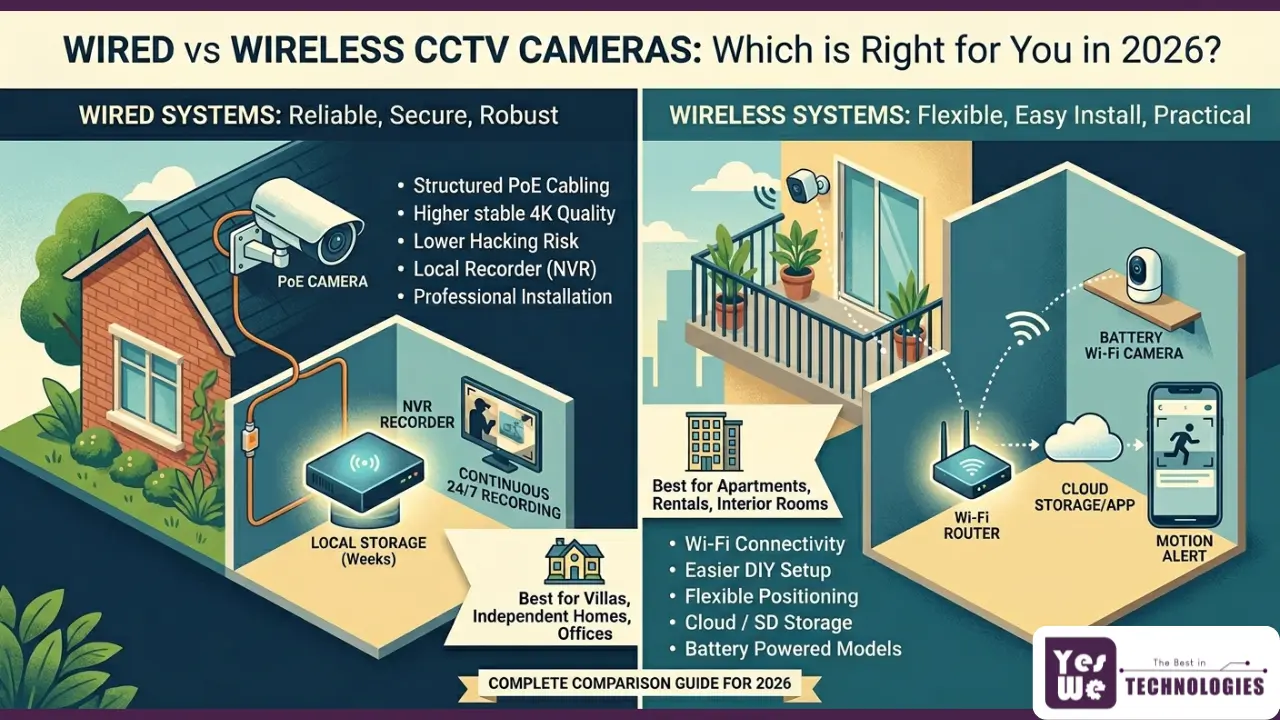
Wired cameras transmit video through a physical cable — either coaxial cable (for older analog/DVR systems) or Ethernet cable (for modern IP/NVR systems). Most modern wired installations use PoE (Power over Ethernet), which means a single Ethernet cable carries both power and high-definition video to the camera. No separate power outlet needed at the camera location.
Because the video signal never leaves the cable, there is no Wi-Fi dependency, no signal degradation through walls, and no bandwidth competition with other devices on your network. Footage is stored locally on a DVR or NVR with hard drives ranging from 1 TB to 10 TB, giving you weeks of continuous recorded footage without any cloud subscription.
Wireless CCTV Cameras

Wireless cameras transmit video over your Wi-Fi network to a router, and from there to cloud storage or a local NVR. They are powered either by rechargeable batteries, a plug-in wall adapter, or solar panels. Installation is straightforward — mount the camera, connect it to Wi-Fi, and you are done.
One important distinction: ‘wireless’ and ‘wire-free’ are not the same thing. A wireless camera still needs a power source. Wire-free cameras run entirely on batteries. If a wireless camera is plug-in powered, it still needs a power cable at the mounting point — just no video cable.
| Quick Clarification: Most people use ‘wireless CCTV’ to mean any camera that transmits video over Wi-Fi rather than a cable. Some of these cameras still require a power cable at the wall. Only battery-powered models are truly wire-free. |
Wired vs Wireless CCTV: The Complete Comparison
| Factor | Wired (PoE/IP) | Wireless (Wi-Fi) |
|---|---|---|
| Installation | Structured cabling, professional setup | DIY-friendly; mount and connect to Wi-Fi |
| Power | PoE or adapter; continuous, no interruption | Battery or plug-in; batteries need periodic charging |
| Video Reliability | Stable; no signal loss or interference | Depends on Wi-Fi strength and network load |
| Latency | Very low (1-2 ms) | Higher (100-250 ms depending on Wi-Fi) |
| Video Quality | High bitrate; stable 1080p to 4K+ | Compressed; quality varies with bandwidth |
| Storage | Local NVR/DVR with large HDD (1-10 TB+) | Cloud (subscription) or SD card (limited) |
| Cybersecurity | Physically closed; minimal hacking risk | Needs strong encryption (WPA2/WPA3) |
| Scalability | High; PoE switches support 8 to 64+ cameras | Limited by router bandwidth and channel load |
| Portability | Fixed installation | Easily moved or repositioned |
| Power Outage | Goes offline without UPS backup | Battery models continue recording |
| Maintenance | Low; no batteries or Wi-Fi issues | Medium; charging, firmware, connectivity checks |
| Long-Term Cost | Higher upfront; lower ongoing | Lower upfront; cloud fees add recurring cost |
Wired CCTV Cameras: Where They Genuinely Win
Wired systems are the right choice when reliability and security are non-negotiable. Here is what makes them the better long-term option for the right property:
Consistent, Interference-Free Recording
Because video travels through a dedicated cable, wired cameras are not affected by Wi-Fi congestion, signal interference from neighbouring devices, or network outages. In a large property with multiple cameras, this reliability is not just convenient — it is essential.
Higher and More Stable Video Quality
Wired cameras can transmit high-bitrate, full-resolution footage without compression. Wireless cameras compress video to fit within available Wi-Fi bandwidth, which can result in reduced clarity, especially during busy network periods or when multiple cameras are recording simultaneously.
Stronger Cybersecurity
Video in a wired system travels only through physical cables to your local recorder. It never passes through a Wi-Fi network that could be intercepted or hacked. For commercial properties, offices, and any location handling sensitive operations, this closed-circuit security is a significant advantage.
Where Wired Systems Are the Right Call
- Large homes, independent houses, and villas in Bangalore with multiple cameras across the property
- Commercial offices, retail stores, warehouses, and industrial facilities
- Gated community perimeter, parking areas, and common zone surveillance
- Any location requiring continuous 24×7 recording with zero tolerance for dropped footage
- Properties under renovation — the ideal time to run wired CCTV infrastructure through walls and ceilings
Wireless CCTV Cameras: Where They Make More Sense
Wireless cameras have closed the quality gap significantly over the past few years. For the right use case, they are not a compromise — they are the better practical choice.
Easy Installation, No Cabling Required
For rented apartments, properties where drilling is not permitted, or locations where running cables through finished walls is simply not practical, wireless cameras are the only workable option. Mount the camera, connect to Wi-Fi, and your system is live in minutes.
Flexible Placement
Wireless cameras can be repositioned whenever your needs change — moved from the living room to the front door, from the main entrance to the car porch, without any rewiring. For households that reconfigure their spaces or move between properties, this flexibility has real value.
Battery Backup During Power Cuts
This is an underappreciated advantage in the Indian context. Wired cameras go offline the moment power fails unless a UPS is installed. Battery-powered wireless cameras continue recording uninterrupted through a power cut — maintaining coverage precisely when a security breach is most likely.
Where Wireless Cameras Are the Right Call
- Compact apartments and 1BHK/2BHK homes in Bangalore where cabling is not practical
- Rented properties where structural modifications are not permitted
- Interior rooms, bedrooms, and supplementary monitoring locations
- Temporary surveillance needs or seasonal monitoring
- Locations where power is intermittent and battery backup is genuinely needed
| Bangalore Note: Many apartment residents in Electronic City, HSR Layout, Koramangala, and Whitefield choose wireless cameras because they cannot drill through walls or modify the building. Modern plug-in wireless cameras with solid Wi-Fi coverage deliver perfectly acceptable video quality for most residential needs. |
Storage Options: DVR, NVR, Cloud, and SD Card
One aspect of the wired vs wireless decision that often gets overlooked is storage. Where your footage is saved affects how long you can keep it, how you access it, and whether you pay a recurring fee.
| Storage Type | Used With | Capacity | Remote Access | Ongoing Cost |
|---|---|---|---|---|
| DVR | Analog wired cameras | 1 to 4 TB typical | Requires network setup | None (one-time hardware) |
| NVR | IP wired and wireless | 1 to 16 TB+ | Built-in, app-based | None (one-time hardware) |
| Cloud | Wireless cameras primarily | Scalable | Yes, native | Monthly subscription |
| SD Card | Wireless cameras | 32 GB to 256 GB | Limited | None (card cost only) |
For most homes and businesses in Bangalore, a local NVR with a 2 to 4 TB hard drive provides 30 to 60 days of continuous recording without any subscription fee. Cloud storage adds convenience and off-site backup, but the monthly cost compounds quickly across multiple cameras.
Power Outages and Backup: An Important Consideration for Indian Homes
India’s power infrastructure is reliable in most urban areas, but short interruptions are not uncommon — particularly in older residential zones or during monsoon season. This makes the power resilience of your CCTV system worth thinking about carefully.
Wired cameras on PoE go completely offline the moment your router or PoE switch loses power. A UPS (Uninterruptible Power Supply) connected to the switch solves this — the cameras stay on through short outages. For any permanent wired installation, a UPS for the recorder and network switch is a strongly recommended addition.
Battery-powered wireless cameras continue recording independently of the mains supply. If a power outage accompanies a break-in attempt, your battery cameras keep capturing footage while wired cameras without UPS backup go dark. For areas where power reliability is genuinely inconsistent, this is a meaningful advantage.
The Hybrid Approach: Most Professional Installations Use Both

There is no rule that says you must choose one or the other. The most effective CCTV systems for homes and businesses in Bangalore typically combine both technologies: wired cameras for critical, permanent coverage zones and wireless cameras for flexible, supplementary locations.
A typical hybrid layout for a Bangalore independent home might look like this:
- Wired PoE cameras: main entrance gate, front door, back entrance, parking area, and stairwells — locations that need 24×7 high-quality recording
- Wireless cameras: living room, kitchen, first-floor corridor, or any interior room where running a cable through finished walls is impractical
Both camera types can be managed through a single NVR or cloud platform, giving you one interface for all cameras regardless of connection type.
Smart Features Worth Looking For in 2026
Whether wired or wireless, modern CCTV cameras have moved well beyond simple video recording. When choosing a system, these features are worth prioritising:
- AI motion detection: distinguishes humans from animals, vehicles, and irrelevant movement — dramatically reduces false alerts
- Facial recognition: identifies known vs unknown faces; useful for home entrances and office reception areas
- Two-way audio: speak to visitors or deter intruders remotely through the camera’s speaker
- License plate recognition: useful for driveways, parking areas, and gated community vehicle management
- Mobile push alerts: real-time notifications to your phone when motion is detected
- Smart home integration: CCTV connected with access control, intruder alarms, smart locks, and home automation scenes
- 4G/LTE backup: cameras with SIM fallback maintain recording even if your Wi-Fi or broadband goes down
Which System Suits Your Bangalore Home or Business?
| Property Type | Recommended System | Key Reason |
|---|---|---|
| Apartment (2BHK/3BHK) | Wireless or plug-in Wi-Fi cameras | No cabling needed; good Wi-Fi in modern buildings |
| Independent home / villa | Wired PoE or hybrid system | Multiple entry points; long-term reliability matters |
| Rented property | Wireless battery cameras only | No structural modifications permitted |
| Commercial office | Wired PoE with NVR | Enterprise reliability; continuous 24×7 recording |
| Retail store or showroom | Wired PoE + wireless for flexible zones | High-detail recording; scalable as needed |
| Gated community unit | Wireless for unit interior; wired for common areas | Interior flexibility; perimeter needs reliability |
| Property under construction | Plan wired infrastructure during build | Lowest cost and cleanest installation |
Additional read: How to Choose the Right CCTV Camera for Your Home or Business?
Professional CCTV Installation in Bangalore: Yes We Technologies
Choosing between wired and wireless CCTV is the first decision. Getting the placement right, sizing the storage correctly, configuring remote access, integrating the system with your smart home, and ensuring it actually performs when you need it — that is where professional installation makes a real difference.
Yes We Technologies is Bangalore’s trusted security and smart home automation company, delivering end-to-end CCTV camera installation services for homes, apartments, villas, and commercial spaces across the city. Whether you need a simple wireless setup for your apartment in Koramangala, a wired IP camera system for your independent home in Whitefield, or a hybrid CCTV and access control solution for your office in Hebbal or Electronic City, the team at Yes We Technologies designs and installs a system that fits your property and your security goals.
What you get when you work with Yes We Technologies for CCTV installation in Bangalore:
- Site survey and camera placement consultation — coverage mapped to your actual property layout
- Wired PoE and wireless IP camera installation — both systems, or a hybrid of the two
- NVR and DVR setup with local storage configuration — sized for your retention requirements
- Remote access configuration — live view and playback from your mobile, anywhere
- Smart home integration — CCTV connected with intruder alarms, access control, smart locks, and automation scenes
- AI-enabled cameras with motion detection, facial recognition, and real-time mobile alerts
- Post-installation support and Annual Maintenance Contracts for long-term reliability
Yes We Technologies serves homeowners and businesses across Whitefield, Indiranagar, Koramangala, Sarjapur Road, Hebbal, Electronic City, Jayanagar, JP Nagar, HSR Layout, Marathahalli, Bellandur, Devanahalli, and all areas across Bangalore.
| Get in Touch with Our Team today for a free CCTV consultation and site visit. Website: https://yeswe.in/ Phone: +91 9620555565 Email: enquiry@yeswe.in Address: 29, Satya Nivas, 2nd Cross, DLF Main Rd, Nyanappana Halli, Bengaluru, Karnataka 560076 |
FAQs
1. Which is better: wired or wireless CCTV cameras?
Wired cameras offer more consistent reliability, better image quality under high-bitrate conditions, and stronger security — making them the better choice for permanent, large-scale installations. Wireless cameras are easier to install and more flexible, making them better suited for apartments, rentals, and locations where cabling is not practical. Most professional installations use a combination of both.
2. Can wireless CCTV cameras be hacked?
Any camera connected to a network carries some risk. Wireless cameras transmit over Wi-Fi and are more exposed than wired systems. The risk is manageable with strong network passwords, WPA3 encryption, regular firmware updates, and avoiding default camera credentials. Wired cameras in a closed local network are inherently more secure.
3. Do wired CCTV cameras work during power outages?
Wired cameras powered through PoE go offline when the PoE switch or router loses power. Adding a UPS (Uninterruptible Power Supply) to the switch and recorder keeps the system running through short outages. Battery-powered wireless cameras continue recording independently without any backup requirement.
4. What is a PoE camera and how does it work?
PoE stands for Power over Ethernet. A PoE camera receives both its power supply and transmits its video data through a single standard Ethernet cable. This eliminates the need for a separate power outlet at each camera location, makes installation cleaner, and is the current standard for professional wired CCTV systems.
5. What is the difference between a DVR and an NVR?
A DVR (Digital Video Recorder) works with older analog coaxial-cable cameras and converts the analog signal to digital for storage. An NVR (Network Video Recorder) works with IP cameras — both wired Ethernet and wireless Wi-Fi — and processes digital video directly. NVR systems generally support higher resolutions, remote access, and greater scalability than DVR systems.
6. How long do wireless CCTV camera batteries last?
Battery life varies significantly based on resolution settings, motion detection frequency, and environmental conditions. Most wireless CCTV cameras with motion-triggered recording last between 2 and 6 months per charge. Constantly recording cameras drain faster. Solar-powered models extend battery life substantially for outdoor installations with adequate sunlight.
7. Can I mix wired and wireless cameras on the same system?
Yes. Modern NVRs and cloud management platforms support mixed camera types, allowing you to manage both wired and wireless cameras from a single app or interface. This hybrid approach is what most professional installers recommend for complete coverage of a property.
8. Do I need a professional to install CCTV cameras?
Wireless cameras can be self-installed relatively easily. However, professional installation ensures correct camera placement for maximum coverage, proper cable routing and weatherproofing for wired systems, optimised recorder and remote access configuration, and integration with other security systems. For anything beyond a single-camera setup, professional installation delivers meaningfully better results.
9. What smart features should I look for in a CCTV system?
Key features to prioritise in 2026: AI motion detection that distinguishes humans from animals and vehicles, two-way audio, mobile push alerts, night vision with at least 20 metres IR range for outdoor cameras, remote viewing via mobile app, and integration capability with smart home automation systems. For commercial properties, facial recognition and license plate recognition add significant value.
10. How much does CCTV installation cost in Bangalore?
CCTV installation costs in Bangalore vary based on the number of cameras, camera type and resolution, wired vs wireless system, storage requirements, and whether smart home integration is included. Yes We Technologies provides customised quotes after a free site visit — costs are matched to your actual property and security requirements rather than a one-size-fits-all package. Contact us for a free consultation.