

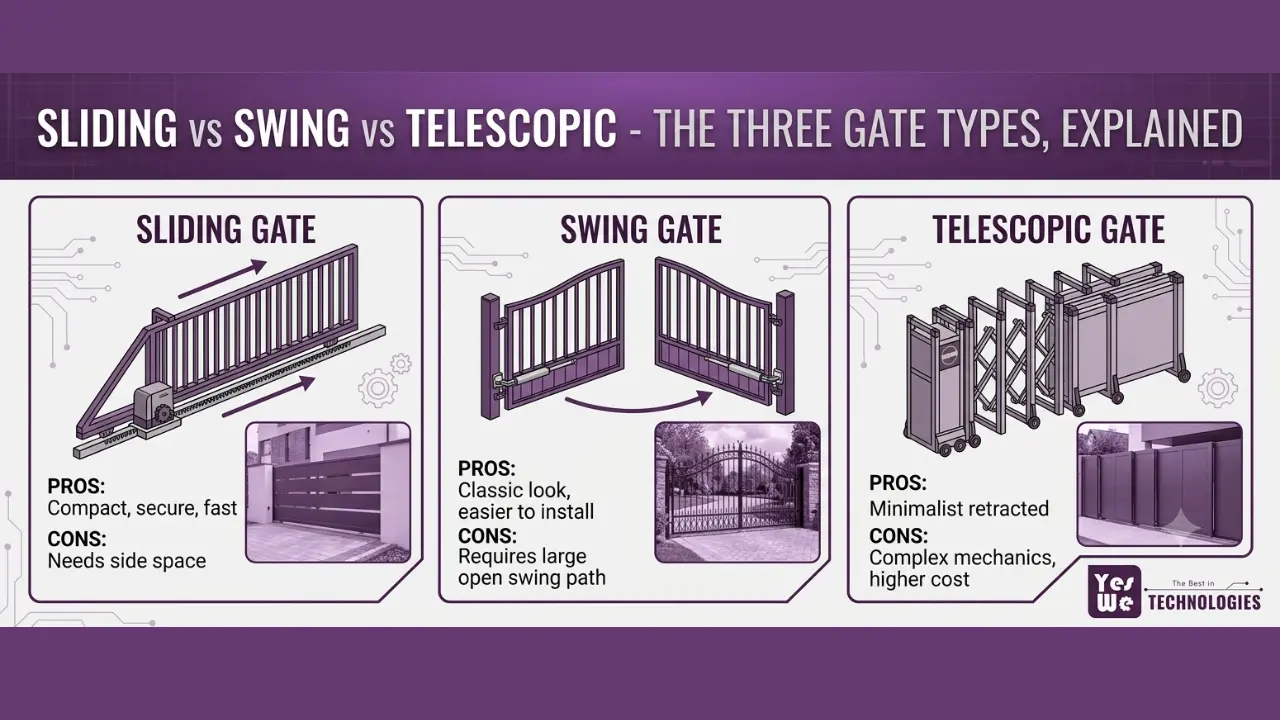
Sliding, swing, and telescopic are the three gate types almost every homeowner runs into when researching a new driveway gate. They look different, but the real distinction between them has nothing to do with style — each one solves a different physical problem of space, slope, or opening width.
Most people start by asking which gate looks best. That is the wrong starting question. The right question is: which gate type actually fits your driveway? Get the type wrong, and no amount of automation technology fixes it later.
This guide explains exactly how each gate type works, where it genuinely excels, and gives you a clear, practical way to decide — based on real driveway conditions across Bangalore homes, not just aesthetic preference.
Key Takeaways
| 💡 Sliding gates work best for sloped, narrow, or compact driveways — common across gated communities in Whitefield and Sarjapur Road. 💡 Swing gates suit wide, flat driveways with traditional architecture — popular in independent houses in Jayanagar and Banashankari. 💡 Telescopic gates solve the ‘wide opening, no side space’ problem — increasingly preferred in dense urban plots like Koramangala and HSR Layout. 💡 Slope and side clearance are the two biggest deciding factors — not personal style preference. 💡 Motorised gate automation in India typically costs Rs 65,000 to Rs 3,00,000+ depending on gate type, width, and motor brand. 💡 Battery backup (UPS) and manual override are standard on quality automation systems — power cuts are not a reason to avoid automation. 💡 A free site assessment before choosing a gate type prevents the single most common and most expensive installation mistake. |
The Three Gate Types, Explained
Before comparing them side by side, it helps to understand exactly how each type works and where each one genuinely excels.
Sliding Gates
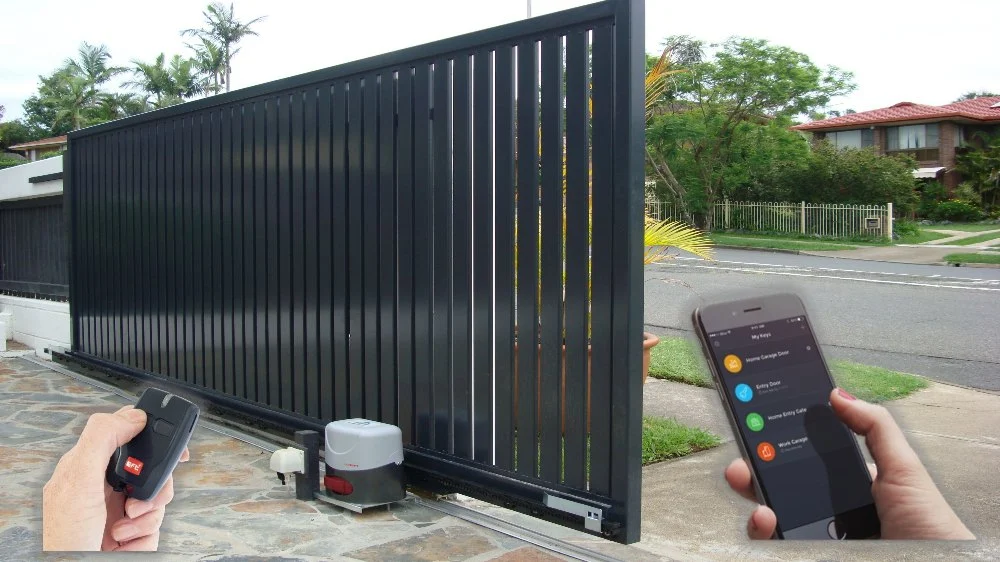
A sliding gate moves horizontally along a track or cantilever rail, running parallel to your boundary wall or fence line, rather than swinging open into your driveway.
Where it wins: Sliding gates need no swing clearance at all, which makes them the default choice for sloped or uneven driveways where a swing gate would simply hit the ground. They also handle wide entrances well and are considered the most reliable option for frequent, heavy-duty automation — ideal for gated community entrances with regular vehicle movement.
What to plan for: You need clear side run-off space roughly equal to the gate’s width for the gate to slide into. A ground track requires periodic clearing of debris and dust; a cantilever system (no ground track, rollers mounted to the side) avoids this but costs more and needs stronger structural support.
Best fit: Gated community apartments, sloped plots, and villas with narrow frontage — common across Whitefield and Sarjapur Road.
Swing Gates
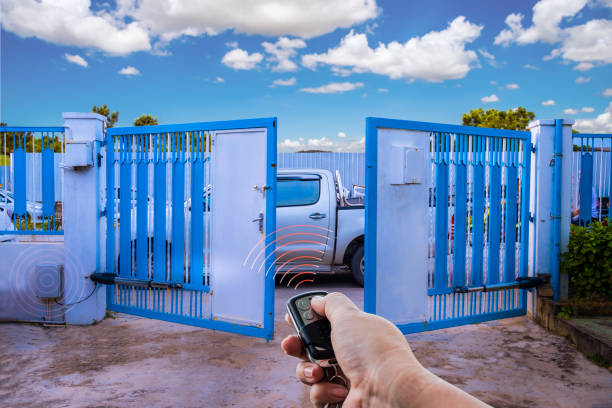
A swing gate opens like a door — inward or outward, on hinges — and can be a single wide panel or a dual-leaf pair that meets in the middle.
Where it wins: Swing gates have the most classic, elegant appearance of the three types and the simplest mechanical design, which generally makes them the most cost-effective to install and maintain. They pair particularly well with brick pillars, stone walls, and traditional or heritage-style architecture.
What to plan for: The gate needs full clearance to swing through its arc, either into the driveway or out toward the road. This makes swing gates unsuitable for driveways that slope upward from the street, and impractical where the approach road is narrow or shared.
Best fit: Independent houses with wide, flat driveways — common in Jayanagar, Banashankari, and JP Nagar.
Telescopic Gates
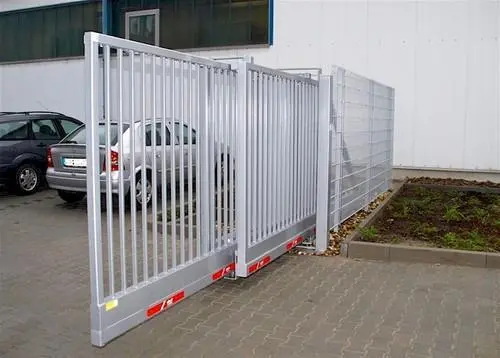
A telescopic gate is a specialised type of sliding gate built from two or more panels that overlap and stack behind one another as the gate opens — allowing a wide gate to retract into a much smaller storage footprint.
Where it wins: Telescopic gates solve a problem neither sliding nor swing gates can: a wide entrance with very little side space to store the gate when open. They are purpose-built for exactly this scenario, which is increasingly common on narrow urban plots.
What to plan for: More overlapping panels mean more moving parts, more precise installation requirements, a level surface, and a higher upfront investment than standard sliding or swing systems.
Best fit: Urban Bangalore plots with a wide opening but limited side clearance — common in Koramangala, Indiranagar, and HSR Layout.
Sliding vs Swing vs Telescopic: Side-by-Side Comparison
| Factor | Sliding | Swing | Telescopic |
|---|---|---|---|
| Space needed | Side run-off space | Full swing clearance | Limited side space (panels overlap) |
| Works on a slope | Yes | No — flat ground only | No — flat ground only |
| Best driveway width | Narrow to wide | Wide, flat | Wide, with tight side margin |
| Mechanical complexity | Moderate | Low | High |
| Typical cost in India | Moderate | Lower | Higher |
| Aesthetic | Modern, minimalist | Traditional, elegant | Sleek, space-saving |
| Maintenance focus | Track and roller cleaning | Hinge lubrication | Multi-panel alignment |
| Automation compatibility | Excellent | Excellent | Excellent |
The Three-Question Decision Framework
Style preference should be the last filter you apply, not the first. Run your driveway through these three questions in order, and the right gate type becomes obvious.
- Does your driveway slope upward from the road? If yes, a swing gate is ruled out immediately — choose sliding or telescopic instead.
- Do you have side run-off space roughly equal to the gate’s width? If yes, a standard sliding gate works well. If no, move to telescopic.
- Is your opening wide — 12 feet or more — with minimal side clearance to store an open gate? This is precisely the scenario telescopic gates are built to solve.
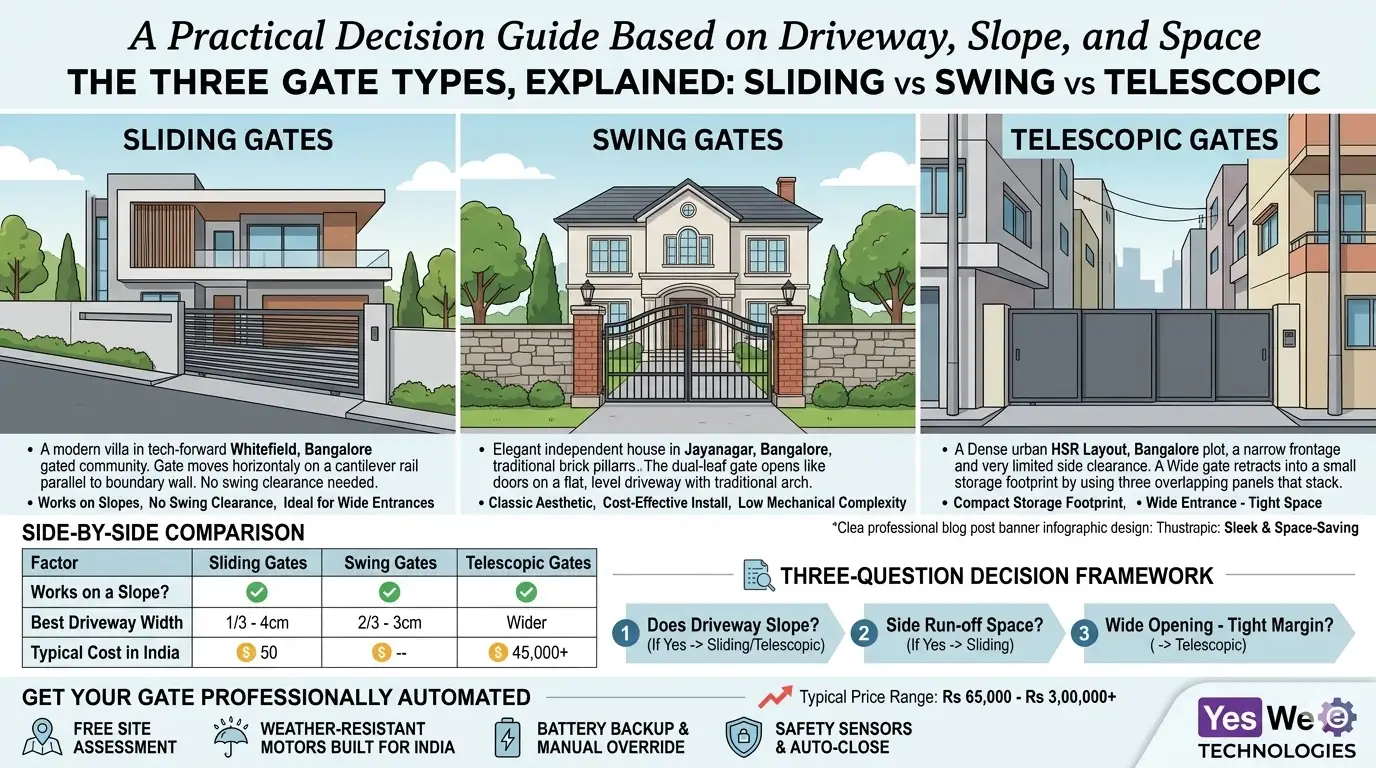
Once the physical constraint is settled, you can choose freely between materials, finishes, and motor brands within that gate type — this is where personal style genuinely belongs in the decision.
Gate Automation Costs in Bangalore
Pricing depends on four factors: gate type, gate width, material (mild steel, stainless steel, or aluminium), and motor brand. As a general guide for the Indian market:
| Gate Type | Typical Price Range (India) |
|---|---|
| Automatic swing gate (basic) | Rs 65,000 – Rs 1,50,000 |
| Automatic sliding gate | Rs 90,000 – Rs 2,00,000 |
| Telescopic sliding gate | Rs 1,50,000 – Rs 3,00,000+ |
| Annual maintenance (any type) | Rs 2,500 – Rs 5,000 per year |
If your existing gate structure is in good physical condition, it can often be retrofitted with a motor and automation kit rather than replaced entirely — a significantly more cost-effective route. A technician will need to check the gate’s weight, balance, and alignment before confirming this is possible.
Power Cuts, Safety, and Mistakes to Avoid
Power Outages Are Not a Reason to Avoid Automation
Quality automatic gate motors sold in India include battery backup (UPS), allowing 50 to 100 gate operations during a power failure — enough to cover any short-term outage. Every system should also include a manual release key as a fallback, so the gate can always be opened by hand if needed.
Safety Features Worth Insisting On
- Obstacle or photocell sensors — the gate stops or reverses if it detects something in its path
- Safety edges on the leading edge of the gate to prevent crush injuries
- Auto-close timer — the gate closes automatically after a set duration, so it is never accidentally left open
These are particularly important for households with young children or elderly residents, and are standard on any quality automation system.
Common Mistakes to Avoid
- Choosing a gate type based on appearance before checking driveway slope and side clearance
- Underestimating daily usage frequency — high-traffic gates need a more robust motor rated for continuous duty
- Skipping professional installation — incorrect force settings on the motor are a genuine safety risk, not just a performance issue
- Not planning for CCTV, video door phone, or access control integration at the time of installation, which costs more to retrofit later
Get Your Gate Professionally Automated
Choosing between sliding, swing, and telescopic is the first decision. Getting the motor sizing, safety sensors, and integration with your broader smart home right is what determines whether the gate performs reliably for the next decade — and that is where professional installation makes the real difference.
Yes We Technologies provides motorised gate automation in Bangalore for homes, gated communities, and commercial properties — sliding, swing, telescopic, and underground motor systems, along with boom barriers and access control for larger properties. Explore the full range of options or book a free site visit, and we will recommend the right type for your driveway.
What you get with Yes We Technologies:
- Free site assessment to determine the right gate type for your specific driveway, slope, and space
- Weather-resistant motors built for Indian conditions, with battery backup and manual override as standard
- Safety sensors — obstacle detection, auto-reverse, and safety edges — on every installation
- Seamless integration with CCTV, video door phones, and smart home access control
- Remote, mobile app, RFID, and voice assistant control (Alexa, Google Assistant)
- After-sales support and Annual Maintenance Contracts for long-term reliability
Serving Whitefield, Indiranagar, Koramangala, Sarjapur Road, Hebbal, Electronic City, Jayanagar, JP Nagar, HSR Layout, and all areas across Bangalore.
| Book a Free Site Visit with Yes We Technologies. Website: https://yeswe.in/ Phone: +91 9620555565 Email: enquiry@yeswe.in Address: 29, Satya Nivas, 2nd Cross, DLF Main Rd, Nyanappana Halli, Bengaluru, Karnataka 560076 |
Frequently Asked Questions
1. Which is better for Bangalore homes — sliding or swing gates?
It depends entirely on your driveway. Sliding gates are the better choice for sloped or narrow driveways, since they need no swing clearance and handle uneven ground well. Swing gates suit wide, flat driveways and are generally the more cost-effective option when the space allows for it. Neither is universally better — the driveway decides.
2. Can a telescopic gate be installed on a sloped driveway?
No. Like sliding gates, telescopic gates require a flat, level surface for the panels to move and overlap correctly. If your driveway slopes, a standard single-track sliding gate is usually the more practical option, since the track can often be adjusted to accommodate moderate gradients better than a multi-panel telescopic system.
3. How much does motorised gate automation cost in Bangalore?
Costs typically range from Rs 65,000 for a basic automatic swing gate to Rs 3,00,000 or more for a premium telescopic gate, depending on width, material, and motor brand. Annual maintenance generally runs Rs 2,500 to Rs 5,000. Contact Yes We Technologies for a free site visit and a quote specific to your property.
4. Can my existing manual gate be converted to automatic?
In most cases, yes. If the existing gate structure is in good condition, a motor and automation kit can be retrofitted onto it, which is significantly cheaper than a full replacement. A technician needs to assess the gate’s weight, balance, and alignment first to confirm compatibility.
5. What happens to an automatic gate during a power cut?
Quality gate motors include a battery backup (UPS) that supports 50 to 100 operations during a power failure, and every system includes a manual release key so the gate can be opened by hand in any situation. Power cuts are not a practical reason to avoid automation in Bangalore.
6. Is gate automation safe for homes with children?
Yes, provided the system includes the right safety features: obstacle detection sensors that reverse the gate if something is in its path, safety edges to prevent crush injuries, and an auto-close timer. These are standard on any quality automation system and significantly reduce accident risk.
7. How long do gate motors last in Bangalore conditions?
A well-maintained motor from a reputable brand typically lasts 8 to 15 years. Dust, humidity, and voltage fluctuations are the main factors affecting lifespan, which is why routine servicing every 6 to 12 months and a good voltage stabiliser are recommended.
8. Which gate type needs the least maintenance?
Swing gates generally need the least ongoing maintenance, since their mechanism is the simplest — mainly hinge lubrication and motor servicing. Sliding gates need periodic track and roller cleaning. Telescopic gates, with multiple overlapping panels, have the most maintenance touchpoints since each panel’s alignment needs to stay precise.
9. Do automatic gates increase property resale value in Bangalore?
Yes. Automated entry systems are consistently cited by real estate agents as a factor that increases buyer interest, and can raise perceived property value in the range of 3 to 8 percent in urban and semi-urban markets, particularly when paired with CCTV and smart home integration.
10. How long does gate automation installation take?
For most residential gates, installation is completed within 1 to 2 days, depending on the gate type and whether civil work is required for tracks or motor housing. Telescopic systems, with their additional panels and alignment requirements, can take slightly longer than sliding or swing installations.