

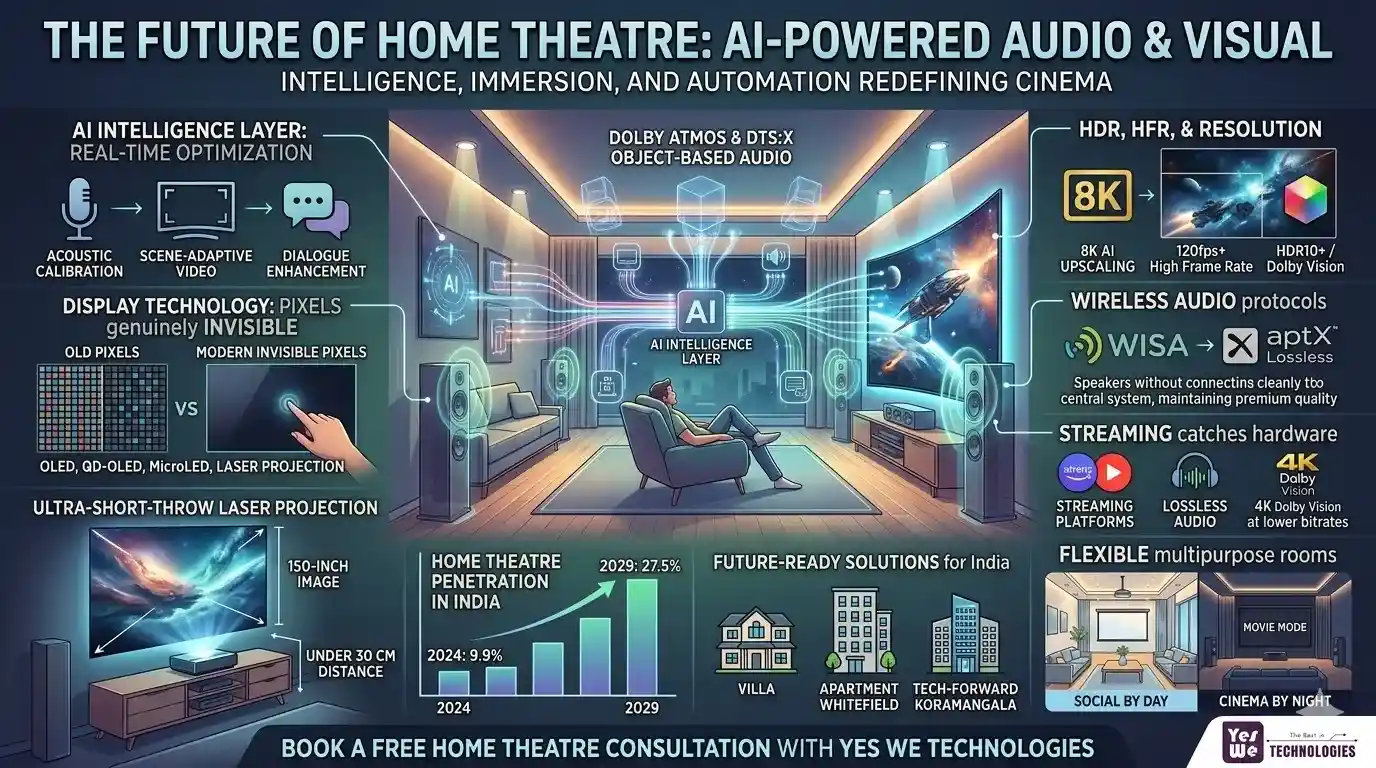
The home theatre experience has always been about one thing: feeling like you are inside the story. For decades, that meant buying a bigger TV and a louder speaker system. But something more fundamental is happening now.
AI is not just an add-on feature in the latest AV receivers. It is becoming the central intelligence layer that listens to your room, analyses every frame of content, learns your preferences, and continuously optimises the experience — all in real time, all without you touching a single setting.
Alongside this, display technology has crossed a threshold where pixels are genuinely invisible. Audio formats have moved from simulating surround sound to placing individual sounds as objects in three-dimensional space. And smart home integration means the room itself responds to what you are watching.
This blog covers seven technology frontiers shaping the future of home theatre — what they are, why they matter, and what they mean for homeowners in India who are building or upgrading their home cinema setups right now.
Key Takeaways
| 💡AI is now the intelligence layer of modern home theatre — calibrating audio, optimising video, and personalising the experience in real time. 💡Display technologies (OLED, QD-OLED, MicroLED, laser projection) have crossed invisible-pixel territory — the screen disappears into the image. 💡Dolby Atmos and DTS:X treat sound as moveable objects in 3D space; AI calibration makes them room-adaptive, not room-dependent. 💡Wireless audio protocols (WiSA, aptX Lossless) have genuinely closed the quality and latency gap with wired speaker systems. 💡Smart home integration transforms home theatre from a system you manage into an experience that responds to your intent. 💡Streaming services are catching up with hardware — lossless audio, high frame rate, and premium content are arriving on-demand. 💡Home theatre penetration in India is projected to grow from 9.9% in 2024 to 27.5% by 2029 — now is the right time to invest in future-ready systems. 💡Professional installation and calibration is what converts technology specifications into a performance that actually delivers. |
The AI Intelligence Layer: What It Actually Does
When AV manufacturers say ‘AI-powered,’ they usually mean one of several specific capabilities. Here is what is actually happening under the hood:
- Room acoustic calibration: Systems like Audyssey MultEQ XT32, Dirac Live, and Yamaha YPAO use AI-driven acoustic measurement to map your room’s geometry, identify reflection points, and generate a precise equalisation correction curve. Modern systems go further — recalibrating in real time as conditions change (furniture rearranged, different number of people present).
- Scene-adaptive video processing: AI analyses content frame by frame, identifying whether a scene is a sunlit exterior, a dark interior, or a fast-action sequence — then adjusts brightness, contrast, and colour temperature accordingly, rather than applying a fixed picture preset to everything.
- Dialogue enhancement: AI isolates the vocal frequency range and lifts it relative to the mix — solving the persistent problem of inaudible dialogue during loud action sequences without manually adjusting the volume.
- Content-aware upscaling: Processors from Sony, Samsung, and LG use AI trained on reference images to reconstruct 2K or 4K content toward higher resolutions. This is genuine perceptual improvement, not simple pixel interpolation.
- Predictive personalisation: Profile-based systems remember your volume level, subtitle settings, and picture mode preferences per genre — and switch automatically when you sit down and start a film.
Combined, these capabilities mean a well-configured modern home theatre system is not just a display and speaker array. It is a system that understands its environment and optimises itself. The gap between a self-installed setup and a professionally calibrated one is where most of this AI potential is either realised or left on the table.
Display Technology: Where Visual Immersion Is Heading
The pixel is becoming invisible. That is not marketing language — it is a genuine engineering milestone that changes what ‘watching a film at home’ means.
OLED, QD-OLED, and MicroLED
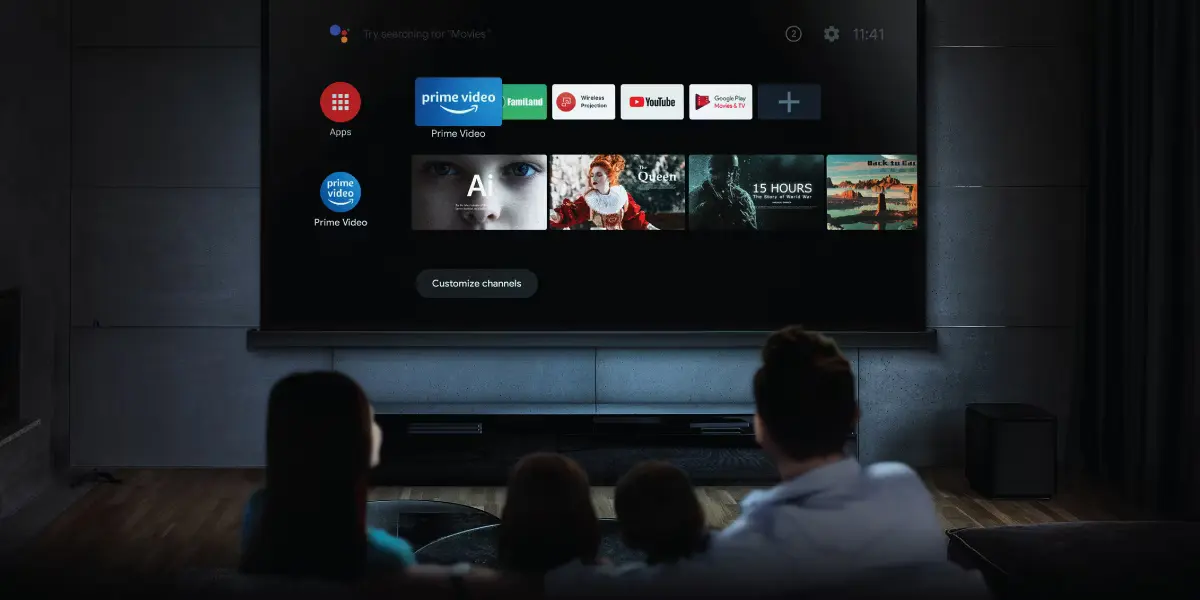
OLED remains the benchmark for contrast and black levels, with self-emissive pixels that switch off completely in dark scenes. Recent generations have pushed past 1,000 nits peak brightness — closing the ambient light gap that was OLED’s main weakness. QD-OLED hybridises OLED’s self-emissive architecture with quantum dot colour technology, delivering improved colour volume and brightness while retaining perfect black levels.
MicroLED is the technology the industry is building toward. Individual microscale LEDs provide each pixel’s own light source — without the burn-in risk of OLED and with scalable resolution to sizes that no single-piece TV panel can match. Currently transitioning from commercial to consumer applications, MicroLED displays already achieve 40,000 local dimming zones and 10,000-nit peak brightness in premium configurations.
Laser Projection
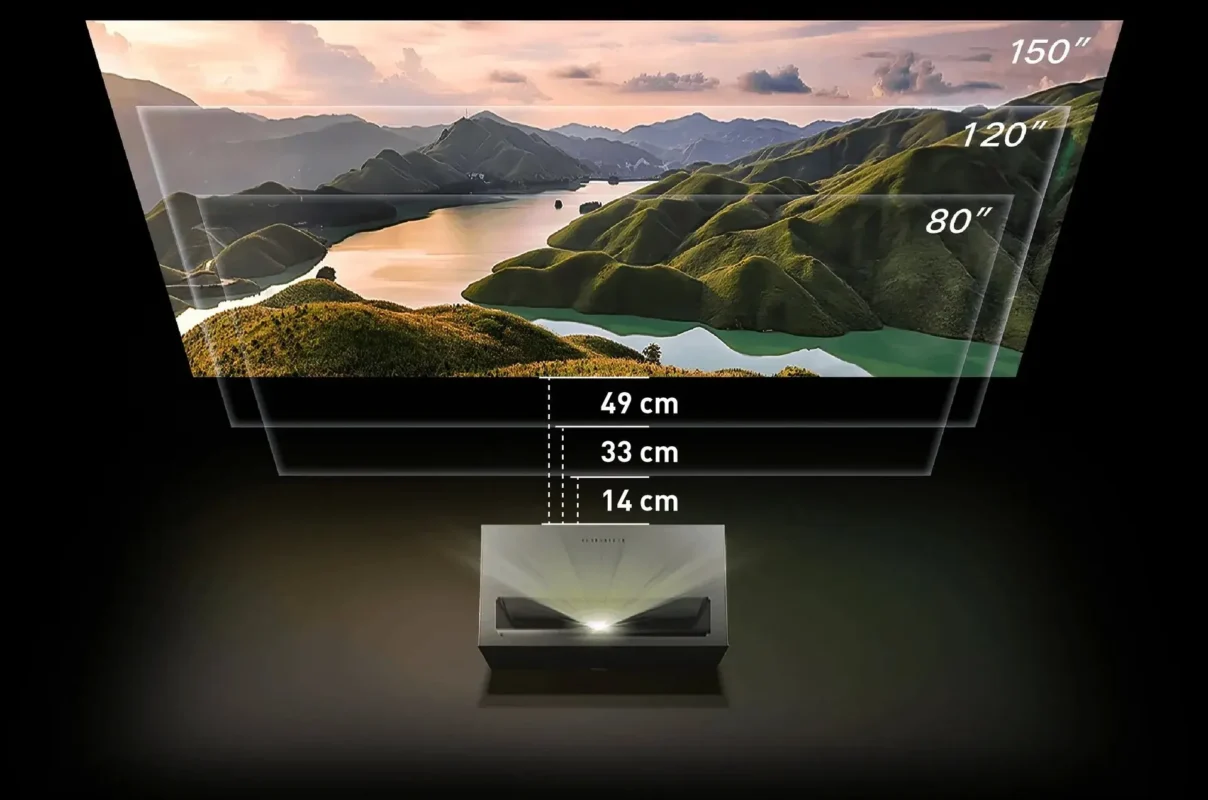
4K and 8K laser projectors have fundamentally changed what projection means for home cinema. With no lamp to replace, consistent brightness across a 30,000-hour lifespan, and wide colour gamut support (DCI-P3, Rec. 2020), modern laser projectors match or exceed premium TV image quality at screen sizes no TV can approach.
Ultra-short-throw laser projectors — projecting 150-inch images from under 30 cm — have removed the last practical barrier for living room projection. You no longer need a dedicated room or a specific ceiling height. The projector sits on a media console like a TV, but the image fills the wall.
| Display Tech | Black Level | Peak Brightness | Screen Size | Lifespan |
|---|---|---|---|---|
| OLED | Absolute (infinite contrast) | 800 to 1,500 nits | Up to 97 inches | 7 to 10 years |
| QD-OLED | Absolute | 1,000 to 2,000 nits | Up to 77 inches | 7 to 10 years |
| MicroLED | Near-absolute | Up to 10,000 nits | Scalable | 100,000+ hours |
| Laser Projector | Depends on room control | 3,000 to 6,000 lumens | 80 to 300+ inches | 30,000+ hours |
HDR, HFR, and the Resolution Question
8K resolution is available in both TVs and projectors. The honest caveat: native 8K content remains limited. The real value of an 8K display today is AI upscaling — the processor reconstructing 4K content with perceptible detail improvement. High Frame Rate (120Hz+) is arguably more immediately impactful for most viewers: sports, gaming, and action sequences at 120fps deliver a clarity of motion that standard 24fps cinema never could.
Audio Technology: The 3D Sound Revolution
Sound is what your body responds to. It is what makes a film feel immersive rather than just visible. The leap from 5.1 surround to object-based audio is the most significant audio advancement since surround sound itself.
Object-Based Audio: What It Actually Means
Traditional surround sound assigns audio to fixed channels (front left, centre, rear right, and so on). Dolby Atmos and DTS:X treat individual sounds as independent objects in 3D space — each with its own position, trajectory, and movement data. A helicopter does not play from the ‘overhead channel’; it is a specific object that the system places directly above you and moves as it crosses the room.
The practical difference is dramatic. Atmospheric effects — rain falling, leaves rustling, crowd murmur — become genuinely spatial rather than directional. Dialogue is precisely anchored to where the speaker stands on screen, even when the camera cuts away.
Where Audio Is Going
- More granular object placement: future formats are expected to double or triple the number of simultaneous audio objects, making complex scenes with many sound sources significantly more realistic
- Binaural rendering: creating convincing 3D audio through just two speakers or headphones — significant for apartments where a full multi-speaker system is not practical
- AI-driven room correction in real time: systems that detect changes in the room during playback and adjust the audio processing mid-session
- Listener recognition: profile switching based on who is in the room, with personalised EQ, dialogue enhancement, and volume levels loading automatically
Wireless Audio: The Quality Gap Is Closed
The previous generation of wireless speakers compromised on latency and audio fidelity. WiSA (Wireless Speaker and Audio Association) and aptX Lossless protocols have addressed both problems. Near-lossless, low-latency wireless audio transmission now makes clean, cable-free speaker installation genuinely viable for premium home theatre — particularly relevant for apartments and rental properties where routing speaker cables through finished walls is not practical.
| Format | Type | Best Known For |
|---|---|---|
| Dolby Atmos | Object-based 3D | Widest content library; mainstream cinema and streaming |
| DTS:X | Object-based 3D | Lossless audio; strong in physical media (Blu-ray) |
| Auro-3D | Height-channel 3D | Natural ambient sound rendering; audiophile focus |
| IMAX Enhanced | Multi-format | Content mastered specifically for home playback |
Smart Home Integration: From System to Experience
The shift that matters most for everyday use is not the individual technology improvements — it is what happens when they all work together through smart home automation.
A well-integrated home theatre should not require you to manage it. It should respond to your intent. The practical gold standard for this is Movie Mode: one command — voice, app, or single button — that simultaneously dims all lights to cinema level, closes motorized curtains, adjusts the AC to your preferred viewing temperature, powers on the AV system, selects the right input, and starts the screen descending if you have a motorized setup.
Beyond Movie Mode, smart integration enables:
- Adaptive environmental control: Lights that respond to content type and ambient light levels. AC that maintains viewing comfort without cycling on loudly. Curtains that close automatically at sunset or on a schedule.
- Security and notification integration: Volume that ducks automatically when the doorbell rings. Security camera feeds that appear in a picture-in-picture overlay during a film.
- Multi-room audio: Seamless extension of the home theatre audio to adjacent spaces — kitchen, corridor, terrace — as a single unified system.
- Voice and app consolidation: Alexa, Google Home, or a single app replacing multiple remotes and inputs. Natural language commands that execute complex multi-device scenes.
For homeowners in Bangalore planning home theatre installations — particularly in independent homes and villas across Whitefield, Sarjapur Road, and Hebbal — the integration layer is what distinguishes a room with good equipment from a room that actually feels like a cinema. And the right time to plan it is during installation, not as an afterthought.
Streaming and Content: The Software Side of the Future
Hardware alone does not deliver a great home theatre experience. Content has to match the capability of the system playing it. The good news: the gap is closing faster than most people realise.
- 4K Dolby Vision with Dolby Atmos audio is now the standard delivery format on Netflix, Apple TV+, Disney+, and Amazon Prime Video — not a premium tier
- Lossless audio (FLAC, MQA) is arriving on streaming platforms; Apple Lossless on Apple Music and spatial audio with Dolby Atmos already available
- High Frame Rate streaming: Apple TV+ and YouTube already deliver 60fps content; sports platforms are moving toward 120fps live streams
- AI video compression allows 4K Atmos streams at lower bitrates without perceptible quality loss — making premium home theatre viable on standard broadband connections
- Cloud gaming through Xbox Cloud, NVIDIA GeForce Now, and PlayStation’s streaming service means the home theatre AV system doubles as a gaming platform without a dedicated console
The biggest near-term shift: films releasing simultaneously to premium streaming and theatres. As this becomes more common, the performance gap between a commercial multiplex and a well-designed home cinema becomes the commercial cinema’s biggest competitive challenge.
Flexible Rooms: The Multipurpose Home Theatre
The dedicated cinema room — dark, purpose-built, permanently configured — is not the future for most Indian homeowners. The future is a room that transforms.
Motorized retractable screens disappear into ceiling cassettes when not in use. Modular seating reconfigures from social to cinema arrangement. Acoustic panels double as wall art. Smart lighting shifts the same space from a bright social environment during the day to a fully immersive cinema at night with a single command.
For larger living rooms in Bangalore villas and independent homes, this multipurpose approach is not a compromise — it is the intelligent design choice. The room earns its square footage every single hour of the day, not just during movie sessions.
Outdoor extension is also growing rapidly: wireless projectors and weatherproof speaker systems are making terrace and garden cinema nights genuinely practical. And gaming integration — 4K at 120fps with Variable Refresh Rate, spatial audio, and large-screen immersion — means the same room serves competitive gaming sessions, family viewing, and dedicated cinema nights without any reconfiguration.
What This Means for Buyers in India — Right Now
India’s home theatre market is on a clear growth trajectory. Penetration was 9.9% in 2024 and is projected to reach 27.5% by 2029. The combination of rising disposable income, premium apartment construction, and OTT platform investment in high-quality content is accelerating adoption faster than most category forecasts predicted.
For homeowners in Bangalore’s tech-forward communities — across Whitefield, Koramangala, HSR Layout, Indiranagar, and Sarjapur Road — this means making smart decisions now about what to invest in and what to wait on:
Invest in now
- AV receiver with Dolby Atmos and DTS:X decoding, HDMI 2.1 inputs, and room correction software — the receiver is your system’s brain; do not underinvest here
- Speakers and acoustic treatment — these have the highest impact on perceived performance and the longest upgrade cycle
- Laser projector or OLED/QD-OLED display — both technologies are mature, stable, and future-ready
- Smart home automation provisions — motorized curtain tracks, smart switch wiring, HVAC integration — plan these during installation, not after
Consider waiting on
- Native 8K display — AI upscaling on current 4K hardware delivers most of the perceptual benefit at a fraction of the cost
- Full VR integration — the content library is not yet there to justify building around it
The most important principle: future-ready is not the same as future-speculative. HDMI 2.1, Dolby Atmos-capable receivers, laser projection, and smart automation are all mature technologies delivering excellent results today — they just also happen to be the right foundation for where home theatre is going over the next decade.
Build the Future of Home Theatre with Yes We Technologies — Bangalore
The technology in this blog is not theoretical. Yes We Technologies is installing AI-calibrated, Dolby Atmos-enabled, smart home-integrated cinema rooms across Bangalore right now — in apartments, independent homes, and luxury villas throughout the city.
Whether you are planning a premium 7.1 Dolby Atmos system with a laser projector and motorized ALR screen in your Whitefield villa, a compact but high-performance home theatre in your 3BHK apartment in Koramangala or Indiranagar, or a fully integrated living room cinema with Movie Mode automation, smart lighting, and HVAC control in an independent home on Sarjapur Road or Hebbal — Yes We Technologies handles the complete journey: acoustic design, display calibration, speaker configuration, smart automation, and post-installation support.
What Yes We Technologies delivers for home theatre in Bangalore:
- Room acoustic analysis and professional AV calibration using Dolby Atmos and DTS:X decoding
- 4K and 8K laser projector installation and calibration; OLED and QD-OLED TV setup with AI picture optimisation
- 5.1 to 7.2.4 Dolby Atmos speaker configuration; in-ceiling and in-wall speaker installation; subwoofer placement and calibration
- Smart home automation: Movie Mode, motorized curtains and screens, dimmable smart lighting, HVAC integration, voice control via Alexa and Google Home
- Acoustic treatment designed to look like interior design features, not recording studio equipment
- Premium brands: Harman Kardon, JBL, Epson, Dolby, Elite Screens — matched to your room and budget
- Full smart home ecosystem integration: CCTV, access control, networking, and automation systems working together
- Annual Maintenance Contracts and post-installation support for long-term reliability
Serving homeowners across Whitefield, Indiranagar, Koramangala, Sarjapur Road, Hebbal, Electronic City, Jayanagar, JP Nagar, HSR Layout, Bellandur, Devanahalli, Marathahalli, and all areas across Bangalore.
| Book a Free Home Theatre Consultation with Yes We Technologies. Website: https://yeswe.in Phone: +91 9620555565Email: enquiry@yeswe.in Address: 29, Satya Nivas, 2nd Cross, DLF Main Rd, Nyanappana Halli, Bengaluru, Karnataka 560076 |
Frequently Asked Questions
1. What is AI room calibration in a home theatre?
AI room calibration uses acoustic measurement microphones and machine-learning algorithms to analyse your room’s geometry, surface materials, and reflection patterns, then generates a precise equalisation correction curve that compensates for the room’s acoustic flaws. Systems like Dirac Live and Audyssey MultEQ XT32 do this automatically. The result is the same speaker system sounding significantly better after calibration than before it.
2. What is the difference between Dolby Atmos and standard surround sound?
Traditional surround sound (5.1, 7.1) assigns audio to fixed channels — sounds come from defined speaker positions. Dolby Atmos treats individual sounds as independent objects in three-dimensional space, each with its own position and movement data. The system places these objects precisely around and above the listener regardless of how many speakers are installed. The practical result: sounds move through the room naturally rather than jumping between fixed speaker positions.
3. Is 8K worth investing in for a home theatre in 2026?
For most buyers, AI upscaling on a high-quality 4K display delivers most of the perceptual benefit of native 8K content at a much lower price point. Native 8K content remains limited, and the bandwidth requirements for 8K streaming are not yet widely met by standard Indian broadband connections. The more impactful investment right now is High Frame Rate (120Hz+) support and a high-quality AI upscaling processor.
4. What does object-based audio mean?
Object-based audio means each sound in the mix is encoded as an independent object with its own 3D position coordinates, rather than being assigned to a fixed speaker channel. When the system plays back the content, it calculates in real time which speakers should reproduce each sound object at what level and timing — adapting to whatever speaker configuration is available. This is fundamentally different from channel-based audio, which simply plays a fixed audio track regardless of speaker count or placement.
5. How does smart home automation improve the home theatre experience?
Smart home automation removes the friction between sitting down to watch and the room being ready for cinema viewing. A single Movie Mode command — triggered by voice, app, or button — simultaneously dims lights, closes curtains, adjusts the AC, powers on the AV system, and starts the content. The room responds to your intent rather than requiring you to manage multiple systems manually. For day-to-day use, this is arguably the biggest quality-of-life improvement a home theatre upgrade can deliver.
6. Are wireless speakers good enough for a home theatre system?
For most room sizes and listening environments, yes — modern wireless audio protocols have closed the quality gap with wired systems. WiSA (Wireless Speaker and Audio Association) delivers near-lossless audio at very low latency; aptX Lossless achieves CD-quality wireless transmission. The remaining advantage of wired speakers is in ultra-high-end audiophile setups where every signal path detail matters, and in very large rooms where wireless range becomes a factor.
7. What is a QD-OLED display and how does it differ from regular OLED?
QD-OLED combines OLED’s self-emissive pixel architecture (which delivers perfect black levels and infinite contrast) with quantum dot colour technology that improves colour volume and peak brightness. Regular OLED panels use white light that passes through colour filters, which limits colour saturation at high brightness. QD-OLED uses blue OLED light converted by quantum dots to produce red and green, resulting in more accurate colours at higher brightness levels without sacrificing the black levels that make OLED special.
8. What is an ultra-short-throw laser projector?
An ultra-short-throw (UST) laser projector projects a large image — typically 100 to 150 inches — from a distance of just 15 to 40 cm from the screen surface. The projector unit sits on a media console directly below or in front of the screen, much like a TV. Because it uses a laser light source rather than a traditional lamp, it maintains consistent brightness across a 30,000-hour lifespan with no lamp replacement required. UST laser projectors are the primary alternative to large-screen TVs for living room home cinema setups.
9. How do I future-proof my home theatre setup in India?
Four components determine future-readiness: HDMI 2.1 compatibility in your AV receiver for 8K/120fps passthrough; Dolby Atmos and DTS:X decoding with enough channels to scale to a 7.2.4 configuration; a display or projector with AI upscaling and HDR10+/Dolby Vision support; and smart home automation provisions — motorized curtain tracks, smart switch wiring, AV control integration — planned during installation rather than retrofitted later. Acoustic treatment is also future-proof by definition: physics does not change.
10. What is the future of home theatre over the next 5 to 10 years?
The trajectory is clear across three dimensions. Displays will continue improving in brightness, colour accuracy, and scalability — MicroLED is the likely dominant technology for large-format premium displays within the decade. Audio will move toward even more granular object placement, binaural 3D rendering through two speakers, and AI-driven personalisation that adapts to individual listeners. And smart integration will increasingly dissolve the boundary between ‘setting up to watch’ and simply watching — the room will know what you need before you articulate it. In India specifically, home theatre is moving from a premium niche to a mainstream consideration for upper-middle-class homeowners, driven by OTT content quality, premium apartment design, and falling equipment costs.