

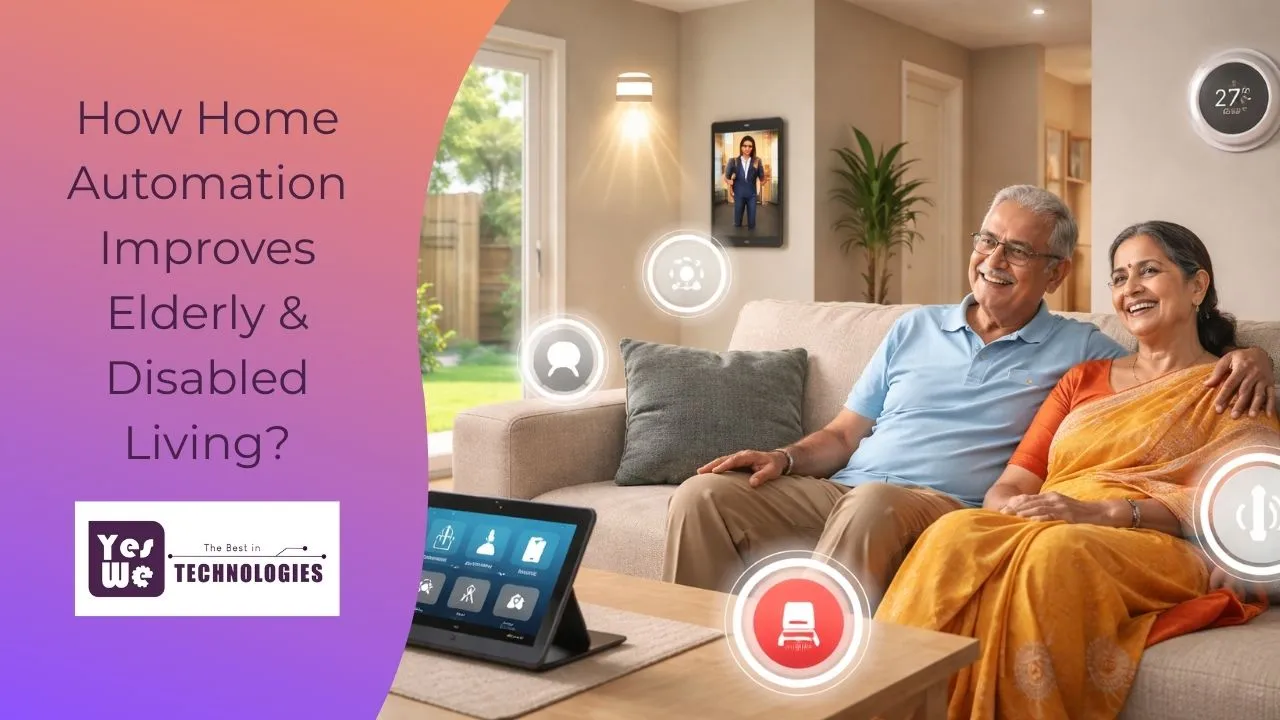
As our lifestyles become faster and families more nuclear, caring for elderly parents or differently-abled family members has become both emotionally important and practically challenging. While human care will always be irreplaceable, home automation is emerging as a powerful support system—helping seniors and people with disabilities live safely, comfortably, and independently in their own homes.
In cities like Bangalore, where families often juggle demanding work schedules and long commutes, smart home automation is quietly transforming assisted living—not by replacing caregivers, but by empowering individuals and offering peace of mind to families.
Why Assisted Living Needs Smarter Homes Today
India’s elderly population is growing rapidly, and so is the number of people living with mobility challenges or chronic conditions. Most seniors prefer to age in place—in familiar surroundings—rather than move to assisted living facilities.
However, traditional homes are not designed with accessibility or safety in mind. Everyday tasks like turning on lights, opening curtains, or reaching switches can become difficult or even risky.
This is where home automation for elderly and disabled living plays a meaningful role—making homes responsive, safer, and easier to navigate.
Common Challenges Faced by Elderly and Disabled Individuals at Home
Before understanding how automation helps, it’s important to recognize the challenges many individuals face daily:
- Difficulty walking or moving around safely
- High risk of falls, especially at night
- Trouble reaching switches, curtains, or door locks
- Forgetting to turn off appliances
- Discomfort due to temperature changes
- Anxiety when alone at home
- Dependence on others for routine tasks
For families, this often translates into constant worry—especially when they are away at work or living in another city.
How Home Automation Supports Independent Living
Home automation doesn’t take control away—it gives it back.
By combining voice control, sensors, automation routines, and remote monitoring, smart homes allow elderly and disabled individuals to manage their environment with minimal physical effort.
Instead of moving around unnecessarily or relying on someone else, they can simply speak, tap a button, or let the system respond automatically.
Key Home Automation Solutions for Elderly and Disabled Living
Let’s look at how specific smart home solutions improve daily life in a practical, human way.
Smart Lighting and Motion Sensors
Poor lighting is one of the biggest causes of falls at home.
With smart lighting automation:
- Lights turn on automatically when movement is detected
- Hallways and bathrooms stay illuminated at night
- Brightness adjusts based on time of day
This reduces fall risks and eliminates the need to search for switches—especially helpful for seniors with mobility or vision challenges.
Voice-Controlled Home Systems
Voice control is one of the most empowering features of home automation.
Elderly or disabled users can:
- Turn lights, fans, or AC on and off using voice commands
- Control the TV or music hands-free
- Open or close curtains without moving
This drastically reduces physical strain and helps maintain independence.
Smart Door Locks and Access Control
Traditional locks can be difficult to use for people with arthritis or limited hand movement.
Smart locks offer:
- Keyless entry using PINs or mobile access
- Automatic locking at night
- Controlled access for caregivers or family members
- Notifications when doors are opened
Families can ensure safety without restricting freedom.
Emergency Alert and Panic Button Systems
One of the most critical features for assisted living is emergency response.
With smart emergency systems:
- A single button press can alert family members or caregivers
- Notifications are sent instantly to smartphones
- Some systems can trigger lights, alarms, or calls automatically
This is especially reassuring for seniors living alone.
Smart Security and Surveillance
Security is not just about intruders—it’s about awareness.
Smart door cameras and indoor cameras allow:
- Seniors to see who is at the door before opening
- Families to remotely check in (without being intrusive)
- Monitoring during travel or emergencies
This creates a strong sense of safety for everyone involved.
Climate Control and HVAC Automation
Elderly individuals are more sensitive to temperature changes.
Smart climate control systems:
- Maintain consistent room temperature
- Automatically adjust cooling or heating
- Prevent overheating or excessive cold
In Bangalore’s fluctuating weather, this helps avoid health issues related to heat or humidity.
Smart Curtains and Blinds
Opening or closing curtains can be physically demanding.
- Open automatically in the morning
- Close at sunset
- Can be controlled by voice or app
This improves natural lighting, comfort, and privacy without effort.
Medication and Routine Reminders
Forgetfulness is common with age.
Smart home systems can:
- Give voice reminders for medicines
- Notify about meals or hydration
- Maintain daily routines
These subtle reminders help seniors stay healthy and confident.
How Automation Improves Safety Inside the Home
Safety is the biggest concern for the elderly and the disabled living.
Automation improves safety through:
- Motion-based lighting to prevent falls
- Fire, gas, and water leak alerts
- Door and window monitoring
- Night-time security routines
- Automatic alerts during emergencies
Instead of reacting to accidents, automation helps prevent them.
Benefits for Caregivers and Family Members
Home automation doesn’t just help the resident—it supports caregivers too.
Families benefit from:
- Remote monitoring without constant calls
- Peace of mind when at work or traveling
- Faster emergency response
- Reduced dependency stress
Care becomes more balanced, respectful, and sustainable.
A Day in an Automated Assisted Living Home
Imagine this daily routine:
- Morning: Curtains open automatically, lights adjust gently, the room warms up.
- Daytime: Motion lights guide safe movement. Door camera verifies visitors.
- Evening: Comfortable lighting, TV controlled by voice, AC adjusts automatically.
- Night: Doors auto-lock, sensors activate, emergency alerts stay ready.
Life feels calmer, safer, and more dignified.
Cost, Scalability, and Customisation
A common myth is that home automation is expensive or complex.
In reality:
- Automation can start small (lighting or security first)
- Systems are modular and scalable
- Solutions can be tailored based on mobility or health needs
This makes smart home solutions for the elderly living accessible and practical.
Why Smart Homes Are the Future of Assisted Living in India
With increasing life expectancy, urban lifestyles, and smaller families, smart homes are becoming essential for assisted living.
They offer:
- Independence without isolation
- Safety without constant supervision
- Comfort without complexity
Home automation is not about technology—it’s about living with dignity.
Conclusion: Technology That Empowers, Not Replaces Care
Home automation doesn’t replace human care—it strengthens it.
By removing everyday obstacles, reducing risks, and simplifying routines, smart homes allow elderly and disabled individuals to live confidently in their own space.
For families, it offers reassurance.
For residents, it restores control.
Create a Safer, Smarter Home with Yes We Technologies
At Yes We Technologies, we specialize in designing custom home automation solutions in Bangalore, with a strong focus on elderly and disabled-friendly living.
We take a consultative, empathetic approach—understanding your family’s needs before designing a system that is safe, simple, and future-ready.
👉 Visit https://yeswe.in to explore how smart home automation can help your loved ones live more independently and securely in Bangalore.